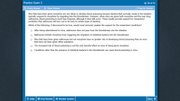
Mice that have been given morphine are very likely to develop blood poisoning because
bacteria that normally reside in the intestine typically respond to morphine by
migrating into the bloodstream. However, when mice are given both morphine and the
new drug naltrexone, blood poisoning is much less frequent, although it does still
occur. These results provide support for researchers' prediction that naltrexone will
turn out to be toxic to certain types of bacteria.
Which of the following, if discovered to be true, would most seriously weaken the
support for the researchers' prediction?
A. After being administered to mice, naltrexone does not pass from the
bloodstream into the intestine.
B. Naltrexone inhibits morphine from triggering the migration of intestinal bacteria
into the bloodstream.
C. Mice that have been given naltrexone but not morphine have no greater risk of
developing blood poisoning than do mice that have not been given either
substance.
D. The increased risk of blood poisoning is not the only harmful effect on mice of
being given morphine.
E. Conditions other than the presence of intestinal bacteria in the bloodstream can
cause blood poisoning in mice.
Premise: Mice given Naltrexone develop blood poisoning much less frequently.
Conclusion: Naltrexone is toxic to bacteria.
To weaken the conclusion, the correct answer must give information suggesting that Naltrexone is NOT toxic to bacteria.
Answer choice
B:
Naltrexone inhibits morphine from triggering the migration of intestinal bacteria into the bloodstream.
Implication:
Naltrexone combats blood poisoning not by killing bacteria but by preventing bacteria from entering the bloodstream, weakening the conclusion that Naltrexone is toxic to bacteria.
The correct answer is
B.
Private tutor exclusively for the GMAT and GRE, with over 20 years of experience.
Followed here and elsewhere by over 1900 test-takers.
I have worked with students based in the US, Australia, Taiwan, China, Tajikistan, Kuwait, Saudi Arabia -- a long list of countries.
My students have been admitted to HBS, CBS, Tuck, Yale, Stern, Fuqua -- a long list of top programs.
As a tutor, I don't simply teach you how I would approach problems.
I unlock the best way for YOU to solve problems.
For more information, please email me (Mitch Hunt) at
[email protected].
Student Review #1
Student Review #2
Student Review #3