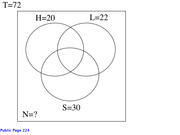
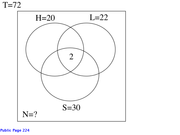
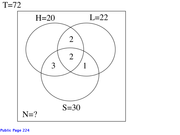
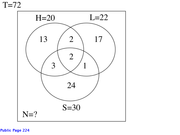
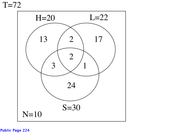
GMATFrantic wrote:Out of 72 track stars, 20 run hurdles, 22 long jump, and 30 sprint. If 5 people sprint and also run hurdles, 4 people run hurdles and also long jump, 3 people sprint and also long jump, and 2 people do all 3, how many track stars do not do any of the events?
A. 10
B. 12
C. 14
D. 16
E. 18
I used the formula: Total = Group 1 + Group 2 + Group 3 - Both - 2*All3 + None
In the formula above,
both represents the number of people in EXACTLY 2 GROUPS.
But the prompt here does not give information about the number of people in exactly 2 groups.
Instead, it gives information about the number of people in AT LEAST 2 GROUPS:
5 people sprint and also run hurdles = people who do AT LEAST these 2 events = (sprint + hurdles) + (all 3 events).
4 people run hurdles and also long jump = people who do AT LEAST these 2 events = (hurdles + long jump) + (all 3 events).
3 people sprint and also long jump = people who do AT LEAST these 2 events = (sprint + long jump) + (all 3 events).
When given information about the number of people in AT LEAST 2 GROUPS, we can use the following formula:
T = G� + G₂ + G₃ - (at least 2) + (all 3) + N.
In the problem above, we get:
72 = 20 + 22 + 30 - (5 + 4 + 3) + 2 + N
72 = 62 + N
N = 10.
The correct answer is
A.
Private tutor exclusively for the GMAT and GRE, with over 20 years of experience.
Followed here and elsewhere by over 1900 test-takers.
I have worked with students based in the US, Australia, Taiwan, China, Tajikistan, Kuwait, Saudi Arabia -- a long list of countries.
My students have been admitted to HBS, CBS, Tuck, Yale, Stern, Fuqua -- a long list of top programs.
As a tutor, I don't simply teach you how I would approach problems.
I unlock the best way for YOU to solve problems.
For more information, please email me (Mitch Hunt) at
[email protected].
Student Review #1
Student Review #2
Student Review #3