Geometry solids

This topic has expert replies
Master | Next Rank: 500 Posts
Posts: 274
Joined: Fri Sep 18, 2015 10:58 pm
Thanked: 12 times
Followed by:1 members
GMAT Score:530

Geometry solids

by vishalwin » Wed Nov 25, 2015 7:57 am
Hi

Can anyone please explain the attached question?


If the question would have been like


What is the volume of the solid then what will be the answer?
Attachments
Screenshot_20151125-212335~01.png
Geometry
Thanks & Regards
vishalwin
------------------------------------
GMAT Score - 530
I will BEAT the GMAT!
Source: — Data Sufficiency |

GMAT/MBA Expert

User avatar
GMAT Instructor
Posts: 16207
Joined: Mon Dec 08, 2008 6:26 pm
Location: Vancouver, BC
Thanked: 5254 times
Followed by:1268 members
GMAT Score:770

by Brent@GMATPrepNow » Wed Nov 25, 2015 8:07 am
What is the volume of a certain rectangular solid?

1. Two adjacent faces have areas 15 and 24 respectively.
2. Each of two opposite faces of the solid has area 40.

This is OG question.

The problem I am facing is understanding second statement.
Can anyone please help in understanding the meaning?

Two opposite faces of rectangular solid will always have same area. So does this statement mean that all 3 pairs of opposite faces have same areas?

Please help.
Target question: What is the volume of a certain rectangular solid?

Aside: A rectangular solid is a box

Statement 1: Two adjacent faces of the solid have areas 15 and 24, respectively.
There are several different rectangular solids that meet this condition. Here are two:
Case a: the dimensions are 1x15x24, in which case the volume is 360
Case b: the dimensions are 3x5x8, in which case the volume is 120
Since we cannot answer the target question with certainty, statement 1 is NOT SUFFICIENT

Statement 2: Each of two opposite faces of the solid has area 40.
So, there are two opposite faces that each have area 40.
Definitely NOT SUFFICIENT

Statements 1 and 2 combined:
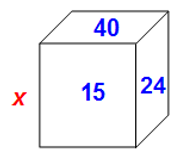
So, we know the area of each face (noted in blue on the diagram below).
Let's let x equal the length of one side.
Image


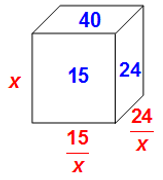
Since the area of each face = (length)(width), we can express the other two dimensions in terms of x.
Image

From here, we'll focus on the face that has area 40.
This face has dimensions (15/x) by (24/x)
Since the area is 40, we know that (15/x)(24/x) = 40
Expand: 360/(x^2) = 40
Simplify: 360 = 40x^2
Simplify: 9 = x^2
Solve: x = 3 or -3
Since the side lengths must be positive, we can be certain that x = 3

When we plug x=3 into the other two dimensions, we get 15/3 and 24/3
So, the 3 dimensions are 3, 5, and 8, which means the volume of the rectangular solid must be 120.
Since we can answer the target question with certainty, the combined statements are SUFFICIENT

Answer = C

Cheers,
Brent
Brent Hanneson - Creator of GMATPrepNow.com
Image

Master | Next Rank: 500 Posts
Posts: 274
Joined: Fri Sep 18, 2015 10:58 pm
Thanked: 12 times
Followed by:1 members
GMAT Score:530

by vishalwin » Wed Nov 25, 2015 8:32 am
Thanks Brent! :)


Can you please answer my another query:

If the question would have been like


What is the volume of the solid then what will be the answer?
Thanks & Regards
vishalwin
------------------------------------
GMAT Score - 530
I will BEAT the GMAT!

GMAT/MBA Expert

User avatar
GMAT Instructor
Posts: 16207
Joined: Mon Dec 08, 2008 6:26 pm
Location: Vancouver, BC
Thanked: 5254 times
Followed by:1268 members
GMAT Score:770

by Brent@GMATPrepNow » Wed Nov 25, 2015 10:05 am
vishalwin wrote:Thanks Brent! :)


Can you please answer my another query:

If the question would have been like


What is the volume of the solid then what will be the answer?
Hi Vishal,

Sorry, I thought I answered your question. When we combine the 2 statements, we can definitely find the volume of the solid. The volume must be 120

Wasn't that your question? Or perhaps I missed something.

Cheers,
Brent
Brent Hanneson - Creator of GMATPrepNow.com
Image

GMAT/MBA Expert

User avatar
GMAT Instructor
Posts: 16207
Joined: Mon Dec 08, 2008 6:26 pm
Location: Vancouver, BC
Thanked: 5254 times
Followed by:1268 members
GMAT Score:770

by Brent@GMATPrepNow » Wed Nov 25, 2015 10:10 am
vishalwin wrote:Thanks Brent! :)


Can you please answer my another query:

If the question would have been like


What is the volume of the solid then what will be the answer?
I re-read your query. Are you asking what the answer would be if the target question didn't tell us that the solid is a rectangular solid?

If that were the case, then the statements wouldn't make any sense. We could have all sorts of solids like pyramids, spheres, doughnut-shaped, etc.

Cheers,
Brent
Brent Hanneson - Creator of GMATPrepNow.com
Image

Master | Next Rank: 500 Posts
Posts: 137
Joined: Fri Nov 13, 2015 11:01 am
Thanked: 1 times
Followed by:2 members

by Amrabdelnaby » Wed Nov 25, 2015 6:21 pm
Another way to solve it would be
LW = 40
LH = 15 --> H = 15/L
WH = 24 --> H = 24/W

H^2 = (24x15)/(LW)
= (24x15) / 40 --> by simplyfing this you get 9

Hence H equal root 9 = 3

SO LWH = 40x3 = 120

which is sufficient :D

Brent@GMATPrepNow wrote:
What is the volume of a certain rectangular solid?

1. Two adjacent faces have areas 15 and 24 respectively.
2. Each of two opposite faces of the solid has area 40.

This is OG question.

The problem I am facing is understanding second statement.
Can anyone please help in understanding the meaning?

Two opposite faces of rectangular solid will always have same area. So does this statement mean that all 3 pairs of opposite faces have same areas?

Please help.
Target question: What is the volume of a certain rectangular solid?

Aside: A rectangular solid is a box

Statement 1: Two adjacent faces of the solid have areas 15 and 24, respectively.
There are several different rectangular solids that meet this condition. Here are two:
Case a: the dimensions are 1x15x24, in which case the volume is 360
Case b: the dimensions are 3x5x8, in which case the volume is 120
Since we cannot answer the target question with certainty, statement 1 is NOT SUFFICIENT

Statement 2: Each of two opposite faces of the solid has area 40.
So, there are two opposite faces that each have area 40.
Definitely NOT SUFFICIENT

Statements 1 and 2 combined:
So, we know the area of each face (noted in blue on the diagram below).
Let's let x equal the length of one side.
Image


Since the area of each face = (length)(width), we can express the other two dimensions in terms of x.
Image

From here, we'll focus on the face that has area 40.
This face has dimensions (15/x) by (24/x)
Since the area is 40, we know that (15/x)(24/x) = 40
Expand: 360/(x^2) = 40
Simplify: 360 = 40x^2
Simplify: 9 = x^2
Solve: x = 3 or -3
Since the side lengths must be positive, we can be certain that x = 3

When we plug x=3 into the other two dimensions, we get 15/3 and 24/3
So, the 3 dimensions are 3, 5, and 8, which means the volume of the rectangular solid must be 120.
Since we can answer the target question with certainty, the combined statements are SUFFICIENT

Answer = C

Cheers,
Brent

Master | Next Rank: 500 Posts
Posts: 274
Joined: Fri Sep 18, 2015 10:58 pm
Thanked: 12 times
Followed by:1 members
GMAT Score:530

by vishalwin » Wed Nov 25, 2015 9:29 pm
Brent@GMATPrepNow wrote:
vishalwin wrote:Thanks Brent! :)


Can you please answer my another query:

If the question would have been like


What is the volume of the solid then what will be the answer?
I re-read your query. Are you asking what the answer would be if the target question didn't tell us that the solid is a rectangular solid?

If that were the case, then the statements wouldn't make any sense. We could have all sorts of solids like pyramids, spheres, doughnut-shaped, etc.

Cheers,
Brent



Yes Brent that's my question what if a solid is not given as rectangular.

So the OA would be E in that case. right?
Thanks & Regards
vishalwin
------------------------------------
GMAT Score - 530
I will BEAT the GMAT!

GMAT Instructor
Posts: 2630
Joined: Wed Sep 12, 2012 3:32 pm
Location: East Bay all the way
Thanked: 625 times
Followed by:119 members
GMAT Score:780

by Matt@VeritasPrep » Fri Nov 27, 2015 1:05 am
vishalwin wrote:
Brent@GMATPrepNow wrote:
vishalwin wrote:Thanks Brent! :)


Can you please answer my another query:

If the question would have been like


What is the volume of the solid then what will be the answer?
I re-read your query. Are you asking what the answer would be if the target question didn't tell us that the solid is a rectangular solid?

If that were the case, then the statements wouldn't make any sense. We could have all sorts of solids like pyramids, spheres, doughnut-shaped, etc.

Cheers,
Brent



Yes Brent that's my question what if a solid is not given as rectangular.

So the OA would be E in that case. right?
Absolutely: for all we know, the figure could look like this!















