BREAKING: Target Test Prep releases Brand New 2026 On Demand GMAT prep course

Redeem

Geometry Triangles

Expert replies
by vishalwin » Wed Nov 25, 2015 7:40 am
Hi

Can anyone please explain the attached question.


What id the position of point D is fixed, then is it able to find answer uaing statement 1?
Attachments
Screenshot_20151125-210600~01.png
Geometry
Thanks & Regards
vishalwin
------------------------------------
GMAT Score - 530
I will BEAT the GMAT!
Join the discussion
Source: — Data Sufficiency |

by Brent@GMATPrepNow » Wed Nov 25, 2015 7:42 am
OG13 DS 149

Image

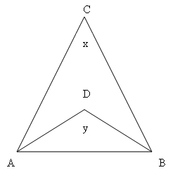
In the figure above, what is the value of x + y
1.x = 70
2.∆ABC and ∆ADC are both isosceles triangles
Important point: For geometry DS questions, we are typically checking to see whether the statements "lock" a particular angle or length into having just one value.

This concept is discussed in much greater detail in our free video: https://www.gmatprepnow.com/module/gmat- ... cy?id=1103

Statement 1 locks angle x by forcing it to have just one value (however it does not lock angle y).

Statement 2 forces the two triangles to be isosceles but the statement does not force the angles to have any particular values.

When we combine the statements, we should try to mentally grab points and try to move them (and still conform to the rules dictated by the statements). In this question, we can "grab" point D and pull it up or down, while still maintaining a 70-degree angle for x AND keeping the triangles as isosceles triangles. As we move point D up and down, angle y changes. So, there's now way that x+y can have a fixed value.

This means the answer is E

Cheers,
Brent
Brent Hanneson - Creator of GMATPrepNow.com
Image
Join the discussion

by Brent@GMATPrepNow » Wed Nov 25, 2015 7:42 am
double post
Brent Hanneson - Creator of GMATPrepNow.com
Image
Join the discussion

by Matt@VeritasPrep » Fri Nov 27, 2015 1:10 am
Well, it "is" fixed, we just don't know where. From S1, we also don't know that C and D both lie on the altitude from C to AB, or that both ∆s are isosceles, among other things.
Join the discussion