BTGmoderatorLU wrote:If a rectangle with length $\sqrt{a}$ units and width $\sqrt{b}$ units is inscribed in a circle of radius 5 units, what is the value of a + b?
A. 10
B. 20
C. 25
D. 50
E. 100
The OA is E.
The way I see it you can't solve this problem, there are a million different rectangles...I tried researching this on the internet, and everything I've read says there's an infinite number of solutions.
Please, can someone assist me with this question? Thanks in advance!
"Inscribed" means that all vertices of the rectangle will touch the edge of the circle. For any given rectangle, there is only one circle that will perfectly inscribe it:
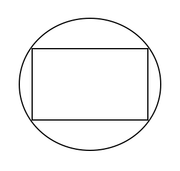
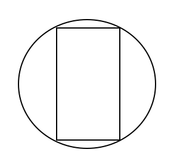
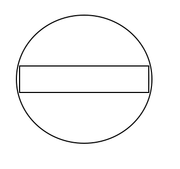
The diagonal of the inscribed rectangle must always be the DIAMETER of the circle:
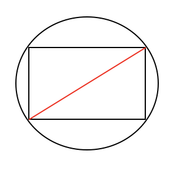
Thus, if you know the diameter of the circle, you will always know the diagonal of the rectangle.
However, to your point... there are an infinite number of rectangles that will have the same diagonal within any given circle:
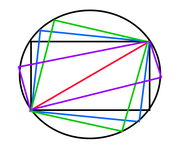
So you're right -
we cannot determine the individual lengths of each side!
However... this question doesn't actually ask us for the lengths of each side individually! It just asks us for the
sum (a + b). Since the side lengths of our rectangle were defined as √a and √b, then (a + b) is the
sum of the squares of those sides.
Think about splitting the rectangle into two right triangles, where the diagonal is the hypotenuse. By definition in pythagorean theorem,
the sum of the squares of the two non-hypotenuse sides equals the square of the hypotenuse: a^2 + b^2 = c^2. In other words, this question is really asking:
what is the square of the hypotenuse (the diagonal of the rectangle).
If we know that the hypotenuse is equal to the diameter of the circle, the hypotenuse = 10. The question is simply asking us for the square of that hypotenuse, so the answer is
E.
Ceilidh Erickson
EdM in Mind, Brain, and Education
Harvard Graduate School of Education























