BREAKING: Target Test Prep releases Brand New 2026 On Demand GMAT prep course

Redeem

Find the total number of ways

Expert replies
Source: — Problem Solving |

by [email protected] » Sat Sep 03, 2016 11:26 am
Hi nahid078,

What is the source of this question? I ask because you have not included the 5 answer choices, the prompt isn't written in proper GMAT 'style' and it's written with few details - for example, are the balls distinguishable from one another or are they 20 identical balls. Those details would impact the math needed to solve.

GMAT assassins aren't born, they're made,
Rich
Contact Rich at [email protected]
Image
Join the discussion

by nahid078 » Wed Sep 07, 2016 12:18 pm
[email protected] wrote:Hi nahid078,

What is the source of this question? I ask because you have not included the 5 answer choices, the prompt isn't written in proper GMAT 'style' and it's written with few details - for example, are the balls distinguishable from one another or are they 20 identical balls. Those details would impact the math needed to solve.

GMAT assassins aren't born, they're made,
Rich
Hello Rich,
Thanks for responding :)

Its from a tutorial video. The answer is given 20*4^19. I didn't understand the explanation well. so i thought anyone might explain it well here. :)
Join the discussion

by [email protected] » Wed Sep 07, 2016 4:11 pm
Hi nahid078,

If we're meant to assume that the 20 balls are unique (meaning that there are no 'duplicates'), then here's how the math works:

Since we have 20 balls, there are 20 different ways to put 1 ball in the first box. After placing that first ball (whichever one it is), each of the remaining 19 balls could be placed in any of the other 4 boxes. With each additional ball, you have to multiply the total by 4. 19 balls = 4^19.

Final Answer: [spoiler] (20)(4^19)[/spoiler]

GMAT assassins aren't born, they're made,
Rich
Contact Rich at [email protected]
Image
Join the discussion

by nahid078 » Wed Sep 07, 2016 11:21 pm
[email protected] wrote:Hi nahid078,

If we're meant to assume that the 20 balls are unique (meaning that there are no 'duplicates'), then here's how the math works:

Since we have 20 balls, there are 20 different ways to put 1 ball in the first box. After placing that first ball (whichever one it is), each of the remaining 19 balls could be placed in any of the other 4 boxes. With each additional ball, you have to multiply the total by 4. 19 balls = 4^19.

Final Answer: [spoiler] (20)(4^19)[/spoiler]

GMAT assassins aren't born, they're made,
Rich

Thanks for your reply. I have a question if you don't mind. if it was said that 2 balls in the 1st box would the answer be 20c2*4^18.

Thanks again :)
Join the discussion

by [email protected] » Thu Sep 08, 2016 9:13 am
Hi nahid078,

Yes - since the 'order' in which the first two balls were placed in the first box would NOT matter, we would have to deal with that part of the calculation by using the Combination Formula. The other 18 balls can be accounted for by 4^18.

GMAT assassins aren't born, they're made,
Rich
Contact Rich at [email protected]
Image
Join the discussion

by Matt@VeritasPrep » Thu Sep 15, 2016 9:19 pm
We actually need to know whether the balls are distinct or not, so this isn't a great question. (The answers are different (i) if all the balls are identical or (ii) they're all distinct or (iii) some of them are, some of them aren't.)
Join the discussion

by jeevansreeram » Fri Sep 16, 2016 12:04 am
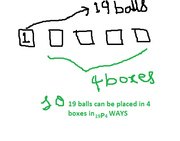
nahid078 wrote:Find the total number of ways in which 20 balls can be put in the 5 boxes so that first box contain just one ball.
Image
Join the discussion

by jeevansreeram » Fri Sep 16, 2016 12:11 am
MY ANSWER IS TRUE I.E. 19P4, WHEN EACH BOX CAN HOLD ONLY ONE BALL
Join the discussion