BREAKING: Target Test Prep releases Brand New 2026 On Demand GMAT prep course

Redeem

Number Properties question.

Expert replies
Source: — Problem Solving |

by tolmar » Sun Aug 03, 2008 10:50 pm
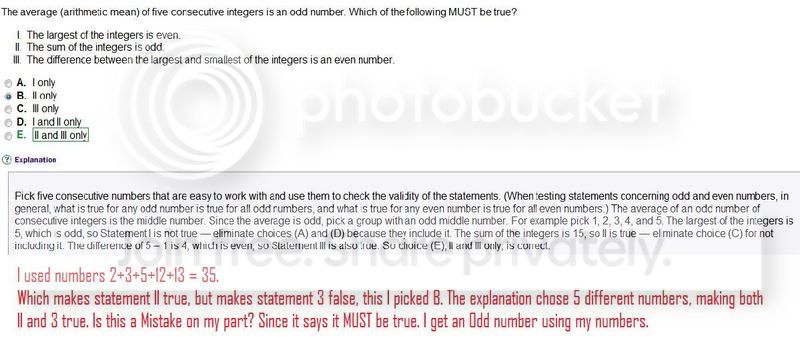
2,3,5,12,13

are not consecutive numbers.

consecutive numbers are only numbers with the difference of 1 between them.
try the question on 3,4,5,6,7.
Join the discussion

by sudhir3127 » Mon Aug 04, 2008 4:54 am
Use 1,2,3,4,5 ..it will be a cake walk...
Join the discussion

by spanlength » Mon Aug 04, 2008 5:06 am
Let x be the 3rd number of the 5 consecutive numbers.
So 5 numbers ar x-2, x-1, x, x+1, x+2 .
for the first option 1) Largest number is not always even --Not always true
2) Sum is always odd-
Sum of above numbers is = x-2 + x -1 + x + x+1 + x+2 = 5x. hence always odd.

3) Difference is (x+2 ) - (x-2 ) = 4 which is even.

Hence ans is E (option 2 and 3 always true).
Join the discussion

by Ian Stewart » Mon Aug 04, 2008 7:05 am
Yes, you do need to notice that the question talks about 'consecutive numbers' here.

I'm curious where the explanation is from, because part of it is mathematical nonsense- the part that says "in general, what is true for any odd number is true for all odd numbers, and what is true for any even number is true for all even numbers". That's true if you only consider addition, subtraction and multiplication, but is not true if you consider division (or other operations- finding remainders, say, or averaging even numbers). If you know a and b are both even, and are asked if a/b is even, you are not free to simply choose any pair of even numbers for a and b. If a and b are both even, a/b could be even, odd, or a non-integer:

8/4 = 2
10/4 = 2.5
12/4 = 3
For online GMAT math tutoring, or to buy my higher-level Quant books and problem sets, contact me at ianstewartgmat at gmail.com

ianstewartgmat.com
Join the discussion

by eccentric » Mon Aug 04, 2008 9:22 am
The option is E
(n-2+n-1+n+n+1+n+2)/5 = n i.e is n is odd integer
smallest no and largest number is odd as well
i ruled out
ii is true o+e+o+e+o = o
iii o+/-o = e
Join the discussion