BREAKING: Target Test Prep releases Brand New 2026 On Demand GMAT prep course

Redeem

Confusing Word Problem-- Please Help

Problem Solving — algebra and arithmetic (GMAT Focus Edition)
Expert replies
Source: — Quantitative Reasoning |

by DavidG@VeritasPrep » Sat Apr 16, 2016 4:07 pm
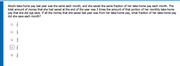
Alice's take home pay last year was the same each month and she saved the same fraction of her take home pay each month. The total amount of money that she had saved at the end of the year was three times the amount of that portion of her monthly take home pay that she did not save. If all the money that she saved last year was from her take home pay, what fraction of her take home pay did she save each month?

(A) 1/2
(B) 1/3
(C) 1/4
(D) 1/5
(E) 1/6
Let's say she saved $1 each month. At the end of the year, she'll have saved $12.

We know that the amount she saved for the whole the year ($12) was three times the amount that she did not save each month. So she must not have saved $4 each month.

If she saved $1 each month and did not save $4 each month, her total monthly pay would be $5. Because she saved $1, she saved 1/5 of her monthly pay. Answer is D
Veritas Prep | GMAT Instructor

Veritas Prep Reviews
Save $100 off any live Veritas Prep GMAT Course
Join the discussion

by Brent@GMATPrepNow » Sat Apr 16, 2016 8:46 pm
Alice's take-home pay last year was the same each month, and she saved the same fraction of her take-home pay each month. The total amount of money that she saved at the end of the year was 3 times the amount of her take-home pay that she didn't save. If all money she saved lasr year was from her take-home pay, what fraction of her pay did she save each month?

a)1/2
b)1/3
c)1/4
d)1/5
e)1/6
Let M = Alice's monthly take home pay
Let f = the fraction we'll use to calculate monthly savings
The means that fM = the amount of $ Alice saves each month.
And this means that her annual savings = 12fM

Important: If f = the fraction used to calculate monthly savings, then 1-f = the fraction used to calculate amount not saved
The means that (1-f)M = the amount of $ Alice does not save each month.

Now we're ready to write an equation.

The total amount of money that she had saved at the end of the year was 3 times the amount of that portion of her monthly take home pay that she did not save.
We get: 12fM = 3(1-f)M
Now solve for f
Expand to get: 12fM = 3M - 3fM
Simplify: 15fM = 3M
Divide both sides by 15M to get: f = 3M/15M = [spoiler]1/5 = D[/spoiler]

Cheers,
Brent
Brent Hanneson - Creator of GMATPrepNow.com
Image
Join the discussion

by [email protected] » Sun Apr 17, 2016 10:35 am
Hi Emeka N.,

We can solve this question with some algebra, but you have to be detailed with how you assign variables.

If...
X = the amount of money Alice EARNED per month
Y = the amount of money Alice SAVED per month
Y/X = the FRACTION of her paycheck she saved per month
then...
12Y = the amount of money Alice saved in ONE YEAR

Since the TOTAL amount saved = 3 times (what she DIDN'T save), we have this...
12Y = 3(X - Y)

Now, we can simplify:
12Y = 3X - 3Y
15Y = 3X
5Y = X
Y/X = 1/5

Final Answer: D

GMAT assassins aren't born, they're made,
Rich
Contact Rich at [email protected]
Image
Join the discussion