This problem involves two overlapping sets (experience vs. no experience and portfolio vs. no portfolio), so we should immediately start making a double matrix. Double matrices help us to organize the information we have so we know what we can and can't figure out. (Note: if we have more than two overlapping sets, a Venn Diagram is probably your best bet.)
So we start by making our matrix:
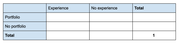
Note that we filled in 1 for the Total number of applicants since we are dealing with fractions.
Then we fill in what we know from the problem:
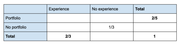
In a double matrix, the top two cells in each column should add up to the total in the bottom cell in the column, and the leftmost two cells in each row should add up to the total in the rightmost cell in the row. This means that if we have two cells in one row or two cells in one columns, we can use that information in the table to fill in the third cell. Let's see what else we can determine in our table:

then
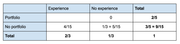
and finally
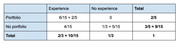
So 2/5 of the applications have both experience and a portfolio. There are 300 total applicants, so 2/5 * 300 = 120.
Note: We didn't actually need to solve for all of the cells in this problem - we only need to solve for enough to get the top left cell (both experience and portfolio). This means we could have gotten away without solving for experience and no portfolio, which would have saved us time converting to fifteenths.
Note 2: You *can* do this kind of problem in your head, but I highly recommend using some sort of diagram to keep track of your information. They're easy to draw on your scratch pad, and they keep you from getting all of those numbers and relationships mixed up.