RiyaR wrote:A certain square is to be drawn on a coordinate plane. One of the vertices must be on the origin, and the square is to have an area of 100. If all coordinates of the vertices must be integers, how many different ways can this square be drawn?
(A) 4
(B) 6
(C) 8
(D) 10
(E) 12
Since the square's area is 100, each side must have length 10.
If all coordinates of the vertices must be integers, we might immediately see that these
4 squares all meet the given conditions:
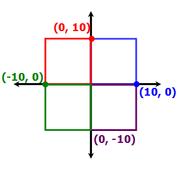
Any others?
You bet.
At this point, we're looking for something called
Pythagorean Triplets. These are sets of three INTEGER values that could be the 3 sides of a right triangle.
The two most common ones to remember for the GMAT are 3-4-5 and 5-12-13.
We should also look out for MULTIPLES of these, such as 6-8-10 and 50-120-130
For this question, the 6-8-10 triplet comes into play. So, the hypotenuse (with length 10) will be one side of the square and the 6 and 8 will be the coordinated of the vertex.
Here are 2 such squares in Quadrant I:
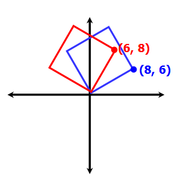
As you might guess, there will be 2 of these types of squares possible in each of the 4 quadrants for a total of
8 squares.
So, the TOTAL number of squares =
4 +
8 =
12
Cheers,
Brent
Brent Hanneson - Creator of GMATPrepNow.com



























