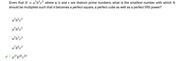
The basic idea here:
To be a perfect square, each exponent must be even.
To be a perfect cube, each exponent must be a multiple of 3.
To be a perfect fifth power, each exponent must be a multiple of 5.
So we want each exponent to be divisible by 2, 3, and 5, i.e. by the LCM of 2, 3, and 5, or 30.
So if we have
(abc)³�
we can write it as
((abc)¹�)²
((abc)¹�)³
((abc)�)�
and see that it's a square, a cube, and a fifth.
From that point, we just need the missing powers to make (abc) raised to the 30th, and we're done!