BTGmoderatorDC wrote:K is a rectangular solid. Find the volume of K
(1) a diagonal line across the front face of K has a length of 40
(2) a diagonal line across the bottom face of K has a length of 25
OA E
Source: Magoosh
You can easily
test values to prove insufficiency.
(1) a diagonal line across the front face of K has a length of 40
This give us limited information about 2 of our dimensions, but nothing about the 3rd. It's easy to imagine 40 as the hypotenuse of a 3 : 4 : 5 triangle, so we can imagine side lengths of 24 and 32. But what's the other dimension? It could be 1, or it could be 100, etc. This doesn't tell us about volume.
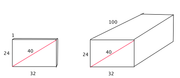 (2) a diagonal line across the bottom face of K has a length of 25
We can apply the same logic as with (1). Knowing 1 diagonal gives limited information about 2 of the 3 dimensions, but nothing about the 3rd. Insufficient.
(1) & (2) Together
With statement 1, we could easily imagine nice, clean integers. For this one, we can't quite as easily off the tops of our heads. But... we know that 25^2 = 625, and you might know that 24^2 = 576. The difference is 49, so it turns out that a 7: 24 : 25 is an all-integer right triangle. (Even if you didn't know these exact values, you could picture a triangle with one side length of 24 and a diagonal of 25, so another side length that's quite a bit shorter than 24).
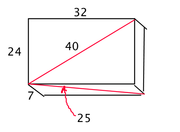
The dimensions of this rectangular solid would be 32*24*7.
We could also imagine a version with a perfectly square bottom face, with side lengths of 25/(sqrt(2)), or approximately 18.
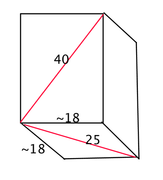
We don't need to calculate the other dimensions - we can see that the more cube-like it is, the greater its volume would be.
By contrast, imagine stretching it out so the depth is negligible, and the bottom length is almost 25. We could have a diagonal of 25 with hardly any depth at all, and a short-but-long front face with a diagonal of 40. Clearly the less regular (the less cube-like) we get, the smaller the volume becomes.
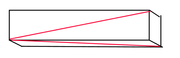
This is insufficient. The answer is
E.
Ceilidh Erickson
EdM in Mind, Brain, and Education
Harvard Graduate School of Education