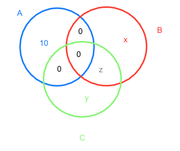
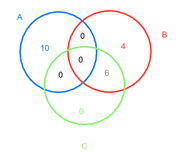
stevecultt wrote:A marketing class of a college has a total strength of 30. It has formed three groups: G1, G2, and G3, which have 10, 10, and 6 students, respectively. If no student of G1 is on either of the other two groups, what is the greatest possible number of students who are on none of the groups?
(A) 6
(B) 7
(C) 8
(D) 10
(E) 14
Of the 30 total students, none of the 10 students in G1 is in G2 or G3.
Thus:
Total number of students in G1, G2 or both = (total number of students) - (students in G1) = 30-10 = 20.
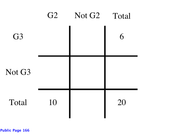
For the remaining 20 students, we can use a DOUBLE-MATRIX.
Total remaining students =20.
Total in G2 = 10.
Total in G3 = 6.
The following matrix is yielded:
Completing the bottom row and the rightmost column, we get:
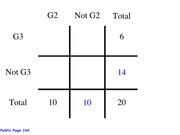
To maximize the number of students in none of the 3 groups, we must maximize the value of the CENTER BOX: the number of students in NEITHER G2 NOR G3.
The value of the center box cannot be greater than the total of the center column (the blue 10) or the total of the middle row (the blue 14 ).
Thus, the greatest possible value for the center box is 10, yielding the following matrix:
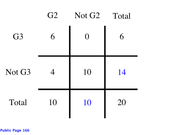
As the matrix illustrates, the greatest number of students who can be in neither G2 nor G3 = 10.
Since none of these 10 students is in G1, the greatest number of students who can be in NONE of the three groups = 10.
The correct answer is
D.
Private tutor exclusively for the GMAT and GRE, with over 20 years of experience.
Followed here and elsewhere by over 1900 test-takers.
I have worked with students based in the US, Australia, Taiwan, China, Tajikistan, Kuwait, Saudi Arabia -- a long list of countries.
My students have been admitted to HBS, CBS, Tuck, Yale, Stern, Fuqua -- a long list of top programs.
As a tutor, I don't simply teach you how I would approach problems.
I unlock the best way for YOU to solve problems.
For more information, please email me (Mitch Hunt) at
[email protected].
Student Review #1
Student Review #2
Student Review #3