BREAKING: Target Test Prep releases Brand New 2026 On Demand GMAT prep course

Redeem

How 20th root of 2 to the 10th power makes this?

Expert replies
by yumi2012 » Mon Aug 12, 2013 8:21 pm
A strain of bacteria multiplies such that the ratio of its population in any two consecutive minutes is constant. If the bacteria grows from a a population of 5 million to 40 million over the course on an hour, by what factor does the population increase every 10 minutes?

---------

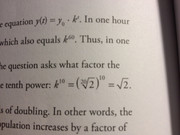
From Manhattan GMAT book, the final solution step before the answer is as follows. I don't question the method or answer itself. I simply don't get how 20th root of 2 to the power of 10 makes square root of 2. Can anyone explain?
Image
Join the discussion
Source: — Problem Solving |

by ganeshrkamath » Tue Aug 13, 2013 12:04 am
yumi2012 wrote:A strain of bacteria multiplies such that the ratio of its population in any two consecutive minutes is constant. If the bacteria grows from a a population of 5 million to 40 million over the course on an hour, by what factor does the population increase every 10 minutes?

---------

From Manhattan GMAT book, the final solution step before the answer is as follows. I don't question the method or answer itself. I simply don't get how 20th root of 2 to the power of 10 makes square root of 2. Can anyone explain?
Image
In 60 minutes the population increases from 5 million to 40 million.
So r^60 = 40/5
r^60 = 8
(r^20)^3 = 2^3
r^20 = 2

To find the factor by which the population increases in 10 minutes, we have to find r^10
r^10 = sqrt(2)

To answer your question,
20th root of 2 = 2^(1/20) = p
p to the power of 10 = p^10 = (2^(1/20))^10 = 2^(10/20) = 2^(1/2) = sqrt(2)

Take a simple example : square root of 9 to the power of 4 = (sqrt(9))^4 = 3^4 = 81
This can also be written as : (9^(1/2))^4 = 9^(4/2) = 9^2 = 81

Cheers
Every job is a self-portrait of the person who did it. Autograph your work with excellence.

Kelley School of Business (Class of 2016)
GMAT Score: 750 V40 Q51 AWA 5 IR 8
https://www.beatthegmat.com/first-attemp ... tml#688494
Join the discussion

by GMATGuruNY » Tue Aug 13, 2013 2:36 am
yumi2012 wrote:A strain of bacteria multiplies such that the ratio of its population in any two consecutive minutes is constant. If the bacteria grows from a a population of 5 million to 40 million over the course on an hour, by what factor does the population increase every 10 minutes?

√2
√3
2
3
4
We can plug in the answer choices, which the GMAT would provide.
The answer choices represent the factor by which the population is multiplied every 10 minutes.
Over the course of 60 minutes, there will be SIX 10-minute periods.
Thus, the population will be multiplied by the correct factor SIX TIMES.
When the correct factor is plugged in, the population will increase from 5 million to 40 million.

Answer choice C: 2
5 * (2*2*2*2*2*2) = 320.
Here, the population increases too much.
Eliminate C, D and E.

Answer choice B: √3
5 * (√3 * √3 * √3 * √3 *√3 *√3) = 135.
Here, the population increases too much.
Eliminate B.

The correct answer is A.

Answer choice A: √2
5 * (√2 * √2 * √2 * √2 *√2 *√2) = 40.
Success!
Private tutor exclusively for the GMAT and GRE, with over 20 years of experience.
Followed here and elsewhere by over 1900 test-takers.
I have worked with students based in the US, Australia, Taiwan, China, Tajikistan, Kuwait, Saudi Arabia -- a long list of countries.
My students have been admitted to HBS, CBS, Tuck, Yale, Stern, Fuqua -- a long list of top programs.

As a tutor, I don't simply teach you how I would approach problems.
I unlock the best way for YOU to solve problems.

For more information, please email me (Mitch Hunt) at [email protected].
Student Review #1
Student Review #2
Student Review #3
Join the discussion

by Brent@GMATPrepNow » Tue Aug 13, 2013 6:07 am
yumi2012 wrote: From Manhattan GMAT book, the final solution step before the answer is as follows. I don't question the method or answer itself. I simply don't get how 20th root of 2 to the power of 10 makes square root of 2. Can anyone explain?
There are two important exponent laws you need to know for this question, and for the GMAT in general.

nth root of x = x^(1/n)
Examples:
fifth root of b = b^(1/5)
cube root of k = k^(1/3)
square root of c = c^(1/2)
20th root of 2 = 2^(1/20)


(x^a)^b = x^ab
Examples:
(x^3)^5 = x^15
(k^2)^9 = k^18
(q^10)^6 = q^60
[2^(1/20)]^10 = 2^(1/2)


So, (20th root of 2)^10 = [2^(1/20)]^10 [using the blue rule]
= 2^(1/2) [using the green rule]
= sqrt2 [using the blue rule]

Cheers,
Brent
Brent Hanneson - Creator of GMATPrepNow.com
Image
Join the discussion