In the rectangular coordinate system which quadrant, if any, contains no point ( x, y ) that satisfies the inequality 2x − 3y ≤ −6 ?
(A) None
(B) Ι
(C) ΙI
(D) ΙII
(E) IV
For those who are unfamiliar with the location of the quadrants in the x-y coordinate plane, they are shown here
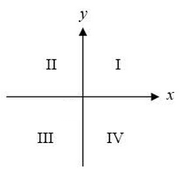
One approach is to recognize how the coordinates of points look in each quadrant.
Quadrant I: (positive, positive)
Quadrant II: (negative, positive)
Quadrant III: (negative, negative)
Quadrant IV: (positive, negative)
From here, we can check each quadrant.
For example, let's see if it's possible for a point in
QUADRANT I (where the x and y coordinates are both positive) to satisfy the inequality 2x − 3y ≤ −6
Well, how about x = 1 and y = 10.
When we plug these in, we get 2(1) − 3(10) ≤ −6
Simplify to get -28 ≤ −6 [PERFECT it works]
Since it IS POSSIBLE for a point to be in quadrant I, we can ELIMINATE B
Is it possible for a point in
QUADRANT II (where the x is negative and y is positive) to satisfy the inequality 2x − 3y ≤ −6?
Well, how about x = -10 and y = 10.
When we plug these in, we get 2(-10) − 3(10) ≤ −6
Simplify to get -50 ≤ −6 [PERFECT it works]
Since it IS POSSIBLE for a point to be in quadrant II, we can ELIMINATE C
Is it possible for a point in
QUADRANT III (where the x is negative and y is negative) to satisfy the inequality 2x − 3y ≤ −6?
Well, how about x = -10 and y = -1.
When we plug these in, we get 2(-10) − 3(-1) ≤ −6
Simplify to get -17 ≤ −6 [PERFECT it works]
Since it IS POSSIBLE for a point to be in quadrant III, we can ELIMINATE D
Is it possible for a point in
QUADRANT IV (where the x is positive and y is negative) to satisfy the inequality 2x − 3y ≤ −6?
NO.
When we plug these in, we get 2(positive) − 3(negative) ≤ −6
Simplify to get positive - negative ≤ −6
Since a positive number minus a negative number will always be positive, we get . . .
POSITIVE ≤ −6
Since this is IMPOSSIBLE, the correct answer must be
E
Cheers,
Brent























