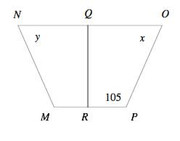
prachi18oct wrote:Hi GMATGuruNY,
Is it necessary that the QR be perpedicular to NO and MP? OG says "Lines shown as straight can be assumed to be straight" so we can safely assume that QR and NO are perpendicular and so are Qr and MP?
We can safely assume that NO, OP, MP, NM and QR are straight lines.
We CANNOT assume that any of these straight lines are parallel or of equal length.
The third figure in my post above illustrates a case in which NO is not parallel to MP:

Statement 2, however, requires that NO be parallel to MP.
Proof:
Since statement 2 implies symmetry about QR, ∠NQR = ∠OQR.
Since ∠NQR + ∠OQR = 180, ∠NQR = ∠OQR = 90.
The same line of reasoning can be used to show that ∠MRQ = ∠PRQ = 90.
The following figure is yielded:

Since NO and MP are both perpendicular to the same line -- QR -- NO and MP must be PARALLEL.
Private tutor exclusively for the GMAT and GRE, with over 20 years of experience.
Followed here and elsewhere by over 1900 test-takers.
I have worked with students based in the US, Australia, Taiwan, China, Tajikistan, Kuwait, Saudi Arabia -- a long list of countries.
My students have been admitted to HBS, CBS, Tuck, Yale, Stern, Fuqua -- a long list of top programs.
As a tutor, I don't simply teach you how I would approach problems.
I unlock the best way for YOU to solve problems.
For more information, please email me (Mitch Hunt) at
[email protected].
Student Review #1
Student Review #2
Student Review #3