grandh01 wrote:In the xy-plane, if line l has negative slope and passes
through the point (-3, q), is the y-intercept of line l positive?
(1) The y-intercept of line l is equal to the x-intercept of
line l.
(2) The slope of line l is -1.
oa is e
Hi grandh01!
This is a tricky (but interesting) problem that really pushes you to think about relationships in the coordinate plane - FUN!
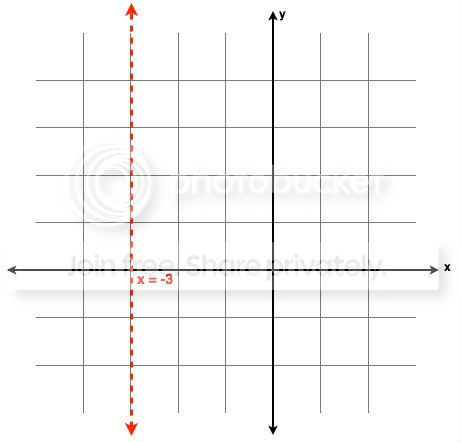
Okay, so let's start with a attempt to figure out the actual question. We have a line L with a negative slope, and all we know is that it hits a point (-3,q). That isn't much, but it is something we can start to sketch. Start with the point. If the line goes through a point with the x-coordinate of -3, then it means that it will have a point on the red dotted line pictured below.
Since we know it will have a negative slope, we can draw several possible lines (see the dotted blue lines for examples).
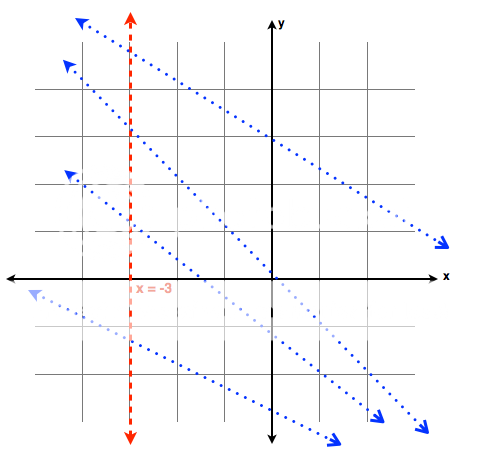
As we can see, some of these lines have a positive Y-intercept and some have a negative Y-intercept. So we certainly can't tell from the question stem alone so we're ready for the statements!
Statement (1): "The y-intercept of line l is equal to the x-intercept of line L.
- what does this mean?? If the x and y intercepts are the same, that means they would have to look like the following:
(1,0) & (0,1) --> positive Y-intercept
(2,0) & (0,2)
(-1,0) & (0,-1) --> negative Y-intercept!!
But does the fact that they have to cross the line x = -3 help?
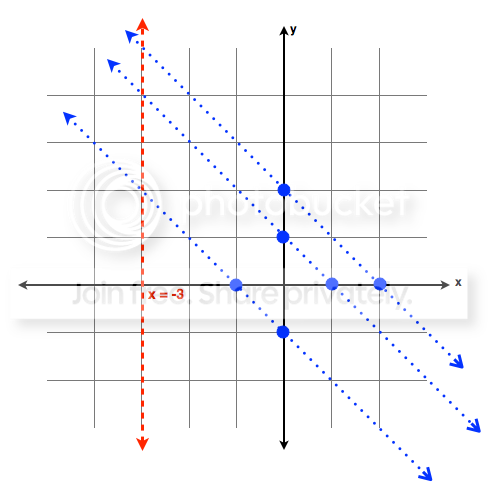
Apparently not, all of the intercepts listed above are on lines that will have a point (-3,q) - in fact, all that we know about a line whose X and Y intercepts are the same, is that its slope = -1 !! [spoiler]NOT SUFFICIENT - eliminate A & D[/spoiler]
Statement (2): "The slope of line L is -1"
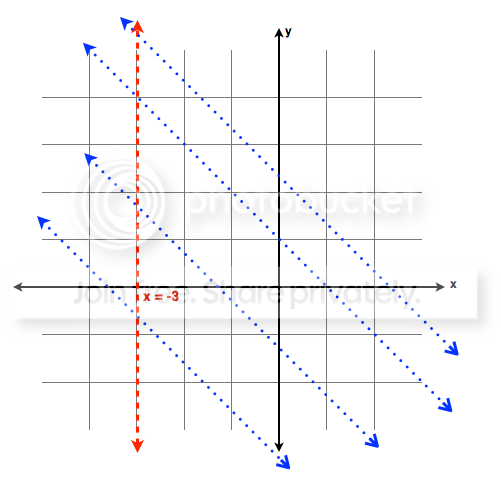
okay, so now I know the exact slope of the line L, but again, I can draw a whole bunch of parallel lines (with slope -1) that cross that line x=-3 and some have a positive Y-intercept and some have a negative Y-intercept (see below)
NOT SUFFICIENT - eliminate B
 Statement (1+2): Putting it all Together
So the real case here is that BOTH statements are tell me the exact same thing (the slope of line L is -1), but that thing just isn't very helpful. So doesn't really do me any more good to put them together!!
[spoiler]
The correct answer is E[/spoiler]
Hope this helps!

Whit























