
BREAKING: Target Test Prep releases Brand New 2026 On Demand GMAT prep course

Redeem

A rectangle has area 24 above. What is the area of the trian

Expert replies
by Max@Math Revolution » Wed Jan 13, 2016 8:08 pm
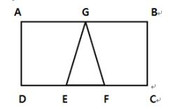
Image


A rectangle has area 24 above. What is the area of the triangle EFG?

1) AD=4
2) EF=CD/3


* A solution will be posted in two days.
Join the discussion
Source: — Data Sufficiency |

by chetan.sharma » Thu Jan 14, 2016 5:21 am
Max@Math Revolution wrote:Image


A rectangle has area 24 above. What is the area of the triangle EFG?

1) AD=4
2) EF=CD/3


* A solution will be posted in two days.
Hi,

If we are given two shapes, same or different, and we are to find certain numeric values, we should look out for..
Any ratios between sides, areas, perimeters etc can help..

We are given area of a rectangle and we are to find area of a triangle formed inside it..

lets see the statements..
1) AD=4
it gives us the other side of rectangle, so sides are 4 and 6.. but no help on triangle..
insuff

2) EF=CD/3
this gives us that the base of triangle is 1/3 of the base of rectangle..
since the area of the two shapes has only height, which is common in both..
the info is suff...
area of rect=24= ht * CD..
area of triangle= 1/2 ht * EF=1/2*ht * CD/3=24/6=4..
suff
ans B
Join the discussion

by Max@Math Revolution » Mon Jan 18, 2016 8:59 pm
Forget conventional ways of solving math questions. In DS, Variable approach is the easiest and quickest way to find the answer without actually solving the problem. Remember equal number of variables and independent equations ensures a solution.

A rectangle has area 24 above. What is the area of the triangle EFG?

1) AD=4
2) EF=CD/3

-> When you modify the original condition and the question, the area of the rectangle is given and the area of the triangle EFG is always the same wherever G is on the line AB. Also, con 1) in number and con 2) is ratio. In this case, it is most likely that ratio is an answer. So, in 2), EF is 1/3 of CD, which means the triangle EFG is 1/6 of the rectangle ABCD. It is unique and sufficient. Therefore, the answer is B.
Join the discussion

















