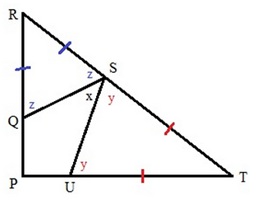
Difficult Geometry problem - Source GMAT Prep 2.2

This topic has expert replies
Source: — Data Sufficiency |

GMAT/MBA Expert

User avatar
GMAT Instructor
Posts: 511
Joined: Wed Aug 11, 2010 9:47 am
Location: Delhi, India
Thanked: 344 times
Followed by:86 members

by Anju@Gurome » Sun Apr 28, 2013 10:59 am
amandeep.hora wrote:In the fig shown, what is the value of x?

1. Length of Line segment QR is equal to Length of Line segment RS.
2. Length of Line segment ST is equal to Length of Line segment TU.
Note that the measure of angle x depends upon the position of points Q, S and U only. Unless we don't know the fixed positions of these three points, we cannot uniquely determine the measure of angle x.

Statement 1: QR = RS
Thus position of Q and S is fixed. But U can be any point on PT and accordingly value of x will be different.

Not sufficient.

Statement 2: ST = TU
Thus position of S and U is fixed. But Q can be any point on PR and accordingly value of x will be different.

Not sufficient.

1 & 2 Together: Now the three points are fixed. Let's see whether we can find x. Refer to the image below.
Image
On point S, the sum of the three angles must be equal to 180°.
Thus, (x + y + z) = 180° ..................................... (i)

angle PQS = (180° - angle RQS) = (180° - z)
angle PUS = (180° - angle TUS) = (180° - y)

Now in quadrilateral PQSU,

Sum of all the internal angles = 360°
--> [x + 90° + (180° - y) + (180° - z)] = 360°
--> (x - y - z + 90°) = 0 .................................. (ii)

Now add (i) and (ii) ---> (2x + 90°) = 180° ---> x = 45°

Sufficient

The correct answer is C.
Anju Agarwal
Quant Expert, Gurome

Backup Methods : General guide on plugging, estimation etc.
Wavy Curve Method : Solving complex inequalities in a matter of seconds.

§ GMAT with Gurome § Admissions with Gurome § Career Advising with Gurome §

GMAT/MBA Expert

User avatar
GMAT Instructor
Posts: 3380
Joined: Mon Mar 03, 2008 1:20 am
Thanked: 2256 times
Followed by:1535 members
GMAT Score:800

by lunarpower » Mon Apr 29, 2013 5:56 am
As Anju pointed out, you should be able to make quick work of the 2 individual statements. Each of them leaves one side completely free to move around, so neither is sufficient.

When it comes to combining the statements, you can take an algebraic approach like Anju's. You can also do 2 other things:

1/ TEST CASES
Plug in random numbers of degrees for angles R and T; just make sure they add up to 90º. Then find x in each case; if x turns out the same every time, then "sufficient".
I.e.,
if angle R = angle S = 45º, then y = z = (180º - 45º)/2 = 67.5º. So x = 180º - 67.5º - 67.5º = 45º.
if angle R = 70º and angle S = 20º, then z = 55º and y = 80º. So x = 180º - 55º - 80º = 45º.
Etc. you'll get 45º every single time.

2/ ALGEBRA WITH ONLY ONE VARIABLE
There's no need for 3 variables here. Just put "y" in angle R.
Then angle T is 90º - y.
Using isosceles triangles, the angles Anju marked "z" are both (180º - yº)/2 = (90 - y/2)º, and the angles she marked "y" are both (180º - (90º - y))/2 = (45 + y/2)º.
So, using the 3 angles that make a straight line at point S,
(90 - y/2) + x + (45 + y/2) = 180
90 + x + 45 = 180
x = 45.

In general, especially on DS, it's a good idea not to use more variables than you have to.
Ron has been teaching various standardized tests for 20 years.

--

Pueden hacerle preguntas a Ron en castellano
Potete chiedere domande a Ron in italiano
On peut poser des questions à Ron en français
Voit esittää kysymyksiä Ron:lle myös suomeksi

--

Quand on se sent bien dans un vêtement, tout peut arriver. Un bon vêtement, c'est un passeport pour le bonheur.

Yves Saint-Laurent

--

Learn more about ron

Senior | Next Rank: 100 Posts
Posts: 81
Joined: Thu May 03, 2012 1:48 pm
Thanked: 4 times

by Blue_Skies » Mon Apr 29, 2013 3:26 pm
Hi Aman,
I also stumbled upon this question. I think i could have gotten the answer if i would have not been scared by the question. Anju pointed out a fantastic way of looking at the questions.

Goodluck

Newbie | Next Rank: 10 Posts
Posts: 1
Joined: Tue Oct 23, 2012 9:36 pm

by nehabhansali2000 » Sun May 26, 2013 2:07 am
Where does it say that the triangle is a right angled triangle?

User avatar
GMAT Instructor
Posts: 15539
Joined: Tue May 25, 2010 12:04 pm
Location: New York, NY
Thanked: 13060 times
Followed by:1906 members
GMAT Score:790

by GMATGuruNY » Sun May 26, 2013 2:50 am
Neither statement alone is sufficient to determine the value of x.
When we combine the two statements, here's an efficient way to determine whether we have sufficient information to determine the value of x:

1. Plug in values for all of the angle measurements, satisfying the constraints in the problem and the rules of geometry.
2. Determine the value of x.
3. Plug in different values for all of the angle measurements, again satisfying the constraints in the problem and the rules of geometry.
3. Determine the value of x.

If the value of x stays the same, we have sufficient information.
If the value of x changes, we have insufficient information.

Below are two sets of angle measurements that satisfy both the rules of geometry and the constraints in the two statements:

∠PRT + ∠PTR = 90 because triangle PRT is a right triangle.
Since QR=RS, ∠RQS = ∠RSQ.
Since ST=TU, ∠UST = ∠SUT.
Since the sum of angles that form a straight line is 180, x = 180 - ∠RQS - ∠UST.

Image

In each case, x=45.
Thus, when the two statements are combined, we have sufficient information to determine the value of x.

The correct answer is C.
Private tutor exclusively for the GMAT and GRE, with over 20 years of experience.
Followed here and elsewhere by over 1900 test-takers.
I have worked with students based in the US, Australia, Taiwan, China, Tajikistan, Kuwait, Saudi Arabia -- a long list of countries.
My students have been admitted to HBS, CBS, Tuck, Yale, Stern, Fuqua -- a long list of top programs.

As a tutor, I don't simply teach you how I would approach problems.
I unlock the best way for YOU to solve problems.

For more information, please email me (Mitch Hunt) at [email protected].
Student Review #1
Student Review #2
Student Review #3