BREAKING: Target Test Prep releases Brand New 2026 On Demand GMAT prep course

Redeem

Target Test Prep · GMAT

Choose how you want to prepare

Learn live with an expert or move at your own pace. Every option includes the complete TTP study system.

★★★★★5.0559 reviews
GMATLiveTeach 7 seats left
Chris Peckover
NEXT LIVE COHORT

Oct 13 to Jan 7, 2027

with Chris Peckover

Schedule
Tue, Thu · 8:00 to 10:00 PM ET
Included
40 live hours + 6 months of GMAT OnDemand
  • Live instruction and real-time questions
  • Class recordings and assigned practice
View class & enroll
Limited cohort · enrollment openTarget Test Prep
EALiveTeach 5 seats left
Logan Thompson
EXECUTIVE ASSESSMENT

Sep 6 to Dec 6, 2026

with Logan Thompson

Schedule
Sun · 9:30 AM to 12:30 PM ET
Included
40 hours of live online classes plus six months of access to the complete TTP EA OnDemand course.
  • 165+ EA Score Guarantee
  • 4,100+ Quant, Verbal, and Integrated Reasoning practice questions
  • 400+ hours of in-depth video lessons
  • 3,000+ step-by-step video solutions
View EA class & enroll
Limited cohort · enrollment openTarget Test Prep
GMATOnDemand Start anytime
SELF-PACED MASTERCLASS

Target Test Prep GMAT OnDemand

Complete access from day one. Study on your schedule.

715+ score guarantee
$0to start then $127/mo
  • Personalized study plan and analytics
  • Thousands of lessons and practice questions

Compare the format, schedule, and included access before enrolling. Prices and seat counts shown reflect the supplied offer details.

If line L has a positive slope, what is the x-intercept of L

Expert replies
Source: — Data Sufficiency |

by GMATGuruNY » Mon Sep 02, 2013 9:11 pm
If line L in the xy-coordinate plane has a positive slope, what is the x-intercept of L ?

(1) There are different points (a, b) and (c, d) on line L such that ad = bc.

(2) There are constants m and n such that the points (m, n) and (-m, -n) are both on line L
Many slope questions can be solved efficiently by DRAWING.

Statement 1: There are different points (a, b) and (c, d) on line L such that ad = bc.
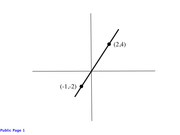
Case 1: a=-1, d=4, b=-2, c=2
Here, line L contains (a,b) = (-1,-2) and (c,d) = (2,4):
Image
Since line L passes through the origin, its x-intercept is 0.

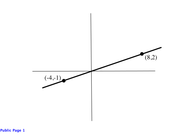
Case 2: a=-4, d=2, b=-1, c=8
Here, line L contains (a,b) = (-4,-1) and (c,d) = (8,2):
Image
Since line L passes through the origin, its x-intercept is 0.

The two random cases above illustrate that -- when ad=bc -- line L must pass through the origin and thus will have an x-intercept of 0.
SUFFICIENT.

Statement 2: There are constants m and n such that the points (m, n) and (-m, -n) are both on line L
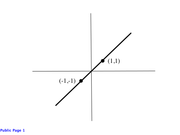
Case 3: m=1 and n=1
Here, line L contains (m,n) = (1,1) and (-m,-n) = (-1,-1):
Image
Since line L passes through the origin, its x-intercept is 0.

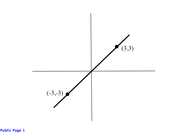
Case 4: m=-3, n=-3
Here, line L contains (m,n) = (-3,-3) and (-m,-n) = (3,3):
Image
Since line L passes through the origin, its x-intercept is 0.

The two random cases above illustrate that -- since Line L contains both (m,n) and (-m,-n) -- it must pass through the origin and thus will have an x-intercept of 0.
SUFFICIENT.

The correct answer is D.
Private tutor exclusively for the GMAT and GRE, with over 20 years of experience.
Followed here and elsewhere by over 1900 test-takers.
I have worked with students based in the US, Australia, Taiwan, China, Tajikistan, Kuwait, Saudi Arabia -- a long list of countries.
My students have been admitted to HBS, CBS, Tuck, Yale, Stern, Fuqua -- a long list of top programs.

As a tutor, I don't simply teach you how I would approach problems.
I unlock the best way for YOU to solve problems.

For more information, please email me (Mitch Hunt) at [email protected].
Student Review #1
Student Review #2
Student Review #3
Join the discussion

by kevincanspain » Tue Sep 03, 2013 3:51 am
Mitch's method is fantastic!

Also, for (1), you could reason as follows:


Any two different points on the line can be written as (a,b) and (c,d)=(a+k, b+mk), where m is the slope of the line, and k is a positive number.

That ad=bc tells us that ab +amk = ba + bk

Thus amk =bk , meaning that am=b.
So (a,b) = (a,am)
If (x,0) is also on this line with slope m, (am)/(a-x) = m ,and assuming that a is not equal to x, a= a - x, and therefore x=0. Thus the x-intercept has to be 0, which is to say that the line passes through the origin

If a=x, (a,b) and (x,0) are the same point, and the line passes through the origin.

In any event, the x-intercept is 0.

Perhaps there is a shorter way to arrive at this conclusion mathematically, but NO way will be more efficient that Mitch's! It's amazing how many questions are best done by means of examples
Kevin Armstrong
GMAT Instructor
Gmatclasses
Madrid
Join the discussion

by kevincanspain » Tue Sep 03, 2013 3:51 am
Mitch's method is fantastic!

Also, for (1), you could reason as follows:


Any two different points on the line can be written as (a,b) and (c,d)=(a+k, b+mk), where m is the slope of the line, and k is a positive number.

That ad=bc tells us that ab +amk = ba + bk

Thus amk =bk , meaning that am=b.
So (a,b) = (a,am)
If (x,0) is also on this line with slope m, (am)/(a-x) = m ,and assuming that a is not equal to x, a= a - x, and therefore x=0. Thus the x-intercept has to be 0, which is to say that the line passes through the origin

If a=x, (a,b) and (x,0) are the same point, and the line passes through the origin.

In any event, the x-intercept is 0.

Perhaps there is a shorter way to arrive at this conclusion mathematically, but NO way will be more efficient that Mitch's! It's amazing how many questions are best done by means of examples
Kevin Armstrong
GMAT Instructor
Gmatclasses
Madrid
Join the discussion

by Mission2012 » Tue Sep 03, 2013 4:24 am
Hi Mitch,

I had a little different approach for (1) -

as (a,b) and (c,d) are different points on the line and ad = bc or b/a = d/c

As for any point (m,n) the slope of line joining the point and origin will have slope = n/m
Hence slope of these two points with line joining them to origin b/a and d/c respectively.

As b/a = d/c, it implies both the point are collinear with origin. Hence x intercept it 0

Is this approach right?
GMATGuruNY wrote:
If line L in the xy-coordinate plane has a positive slope, what is the x-intercept of L ?

(1) There are different points (a, b) and (c, d) on line L such that ad = bc.

(2) There are constants m and n such that the points (m, n) and (-m, -n) are both on line L
Many slope questions can be solved efficiently by DRAWING.

Statement 1: There are different points (a, b) and (c, d) on line L such that ad = bc.
Case 1: a=-1, d=4, b=-2, c=2
Here, line L contains (a,b) = (-1,-2) and (c,d) = (2,4):
Image
Since line L passes through the origin, its x-intercept is 0.

Case 2: a=-4, d=2, b=-1, c=8
Here, line L contains (a,b) = (-4,-1) and (c,d) = (8,2):
Image
Since line L passes through the origin, its x-intercept is 0.

The two random cases above illustrate that -- when ad=bc -- line L must pass through the origin and thus will have an x-intercept of 0.
SUFFICIENT.

Statement 2: There are constants m and n such that the points (m, n) and (-m, -n) are both on line L
Case 3: m=1 and n=1
Here, line L contains (m,n) = (1,1) and (-m,-n) = (-1,-1):
Image
Since line L passes through the origin, its x-intercept is 0.

Case 4: m=-3, n=-3
Here, line L contains (m,n) = (-3,-3) and (-m,-n) = (3,3):
Image
Since line L passes through the origin, its x-intercept is 0.

The two random cases above illustrate that -- since Line L contains both (m,n) and (-m,-n) -- it must pass through the origin and thus will have an x-intercept of 0.
SUFFICIENT.

The correct answer is D.
If you find my post useful -> please click on "Thanks"
Join the discussion

by faraz_jeddah » Tue Sep 03, 2013 9:53 pm
GMATGuruNY wrote:

Statement 1: There are different points (a, b) and (c, d) on line L such that ad = bc.
Case 1: a=-1, d=4, b=-2, c=2
Here, line L contains (a,b) = (-1,-2) and (c,d) = (2,4):
Image
Since line L passes through the origin, its x-intercept is 0.

Case 2: a=-4, d=2, b=-1, c=8
Here, line L contains (a,b) = (-4,-1) and (c,d) = (8,2):
Image
Since line L passes through the origin, its x-intercept is 0.

The two random cases above illustrate that -- when ad=bc -- line L must pass through the origin and thus will have an x-intercept of 0.
SUFFICIENT.

.
Mitch,

For evaluating Statement 1 - How would you know that the line passes through the origin? You would have to find that out using equation of a line which you havent mentioned in your solution.
A good question also deserves a Thanks.

Messenger Boy: The Thesselonian you're fighting... he's the biggest man i've ever seen. I wouldn't want to fight him.
Achilles: That's why no-one will remember your name.
Join the discussion

by GMATGuruNY » Tue Sep 03, 2013 10:07 pm
faraz_jeddah wrote:
For evaluating Statement 1 - How would you know that the line passes through the origin? You would have to find that out using equation of a line which you havent mentioned in your solution.
Connect (-1,-2) and (2.4), and you get a line that passes through the origin.
Connect (-4,-1) and (8,2), and you get a line that passes through the origin.
There is no need to determine the equation of either line.
Private tutor exclusively for the GMAT and GRE, with over 20 years of experience.
Followed here and elsewhere by over 1900 test-takers.
I have worked with students based in the US, Australia, Taiwan, China, Tajikistan, Kuwait, Saudi Arabia -- a long list of countries.
My students have been admitted to HBS, CBS, Tuck, Yale, Stern, Fuqua -- a long list of top programs.

As a tutor, I don't simply teach you how I would approach problems.
I unlock the best way for YOU to solve problems.

For more information, please email me (Mitch Hunt) at [email protected].
Student Review #1
Student Review #2
Student Review #3
Join the discussion

by faraz_jeddah » Tue Sep 03, 2013 10:16 pm
GMATGuruNY wrote:
faraz_jeddah wrote:
For evaluating Statement 1 - How would you know that the line passes through the origin? You would have to find that out using equation of a line which you havent mentioned in your solution.
Connect (-1,-2) and (2.4), and you get a line that passes through the origin.
Connect (-4,-1) and (8,2), and you get a line that passes through the origin.
There is no need to determine the equation of either line.
Dont you think that would leave chance for an error? I mean I just drew a rough graph and I cannot be 100% sure that the x int would be 0. It appears as 0.5 as my grids are not accurate.
A good question also deserves a Thanks.

Messenger Boy: The Thesselonian you're fighting... he's the biggest man i've ever seen. I wouldn't want to fight him.
Achilles: That's why no-one will remember your name.
Join the discussion

by GMATGuruNY » Tue Sep 03, 2013 11:41 pm
faraz_jeddah wrote:
GMATGuruNY wrote:
faraz_jeddah wrote:
For evaluating Statement 1 - How would you know that the line passes through the origin? You would have to find that out using equation of a line which you havent mentioned in your solution.
Connect (-1,-2) and (2.4), and you get a line that passes through the origin.
Connect (-4,-1) and (8,2), and you get a line that passes through the origin.
There is no need to determine the equation of either line.
Dont you think that would leave chance for an error? I mean I just drew a rough graph and I cannot be 100% sure that the x int would be 0. It appears as 0.5 as my grids are not accurate.
Even a rudimentary drawing should be sufficient to see that (a.b) and (c,d) exhibit SYMMETRY about the origin.

Case 1:
(-1,-2) --> left 1, down 2.
(2, 4) --> right 2, up 4.
For each point, the horizontal distance from the origin is 1/2 the vertical distance from the origin.

Case 2:
(-4, -1) --> left 4, down 1.
(8,2) --> right 8, up 2.
For each point, the horizontal distance from the origin is 4 times the vertical distance from the origin.

Since in each case (a,b) and (c,d) exhibit symmetry about the origin, the line that connects them must pass THROUGH the origin.
Private tutor exclusively for the GMAT and GRE, with over 20 years of experience.
Followed here and elsewhere by over 1900 test-takers.
I have worked with students based in the US, Australia, Taiwan, China, Tajikistan, Kuwait, Saudi Arabia -- a long list of countries.
My students have been admitted to HBS, CBS, Tuck, Yale, Stern, Fuqua -- a long list of top programs.

As a tutor, I don't simply teach you how I would approach problems.
I unlock the best way for YOU to solve problems.

For more information, please email me (Mitch Hunt) at [email protected].
Student Review #1
Student Review #2
Student Review #3
Join the discussion

by gmattesttaker2 » Thu Sep 05, 2013 9:03 pm
GMATGuruNY wrote:
If line L in the xy-coordinate plane has a positive slope, what is the x-intercept of L ?

(1) There are different points (a, b) and (c, d) on line L such that ad = bc.

(2) There are constants m and n such that the points (m, n) and (-m, -n) are both on line L
Many slope questions can be solved efficiently by DRAWING.

Statement 1: There are different points (a, b) and (c, d) on line L such that ad = bc.
Case 1: a=-1, d=4, b=-2, c=2
Here, line L contains (a,b) = (-1,-2) and (c,d) = (2,4):
Image
Since line L passes through the origin, its x-intercept is 0.

Case 2: a=-4, d=2, b=-1, c=8
Here, line L contains (a,b) = (-4,-1) and (c,d) = (8,2):
Image
Since line L passes through the origin, its x-intercept is 0.

The two random cases above illustrate that -- when ad=bc -- line L must pass through the origin and thus will have an x-intercept of 0.
SUFFICIENT.

Statement 2: There are constants m and n such that the points (m, n) and (-m, -n) are both on line L
Case 3: m=1 and n=1
Here, line L contains (m,n) = (1,1) and (-m,-n) = (-1,-1):
Image
Since line L passes through the origin, its x-intercept is 0.

Case 4: m=-3, n=-3
Here, line L contains (m,n) = (-3,-3) and (-m,-n) = (3,3):
Image
Since line L passes through the origin, its x-intercept is 0.

The two random cases above illustrate that -- since Line L contains both (m,n) and (-m,-n) -- it must pass through the origin and thus will have an x-intercept of 0.
SUFFICIENT.

The correct answer is D.
Hello Mitch,

Thank you very much for the thorough and excellent explanation.

Best Regards,
Sri
Join the discussion

by Java_85 » Sun Sep 08, 2013 10:09 am
IMO D it is.
Join the discussion


















