B?
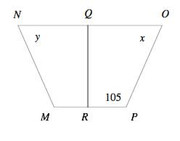
Since its a reflection, we can say that quadrilateral is a trapezium with NO parallel to MP. Now, its possible to get X.
BREAKING: Target Test Prep releases Brand New 2026 On Demand GMAT prep course
Redeem
Target Test Prep GMAT OnDemand
Scott Woodbury-Stewart’s private virtual classroom — 400 hours of master-class video lessons for the GMAT Focus Edition.
- 715+ score guarantee — highest in the industry (99th percentile)
- 52 chapters · 1,500+ lessons · 4,000+ practice questions
- 400 hours of video · 1,500+ instructor-led HD smartboard lessons
- 300,000+ students accepted to Harvard, Stanford, Wharton, Booth & Sloan & more
- 24/7 live support + weekly Zoom office hours with GMAT instructors
- TTP AI Assist — 24/7 AI-powered virtual tutor for instant help
- 1,200+ flashcards + AI-powered study assistant & daily calendar
- OnDemand, LiveTeach & GMAT Bootcamp formats available
- Also: GRE, SAT Math & Executive Assessment courses
- MBA Admissions Consulting now available
- 🏆 2025 EdTech Breakthrough Award: Test Prep Solution Provider of the Year
- 200,000+ students served
- 5-day free trial — $0 to start, no auto-billing, cancel anytime
★★★★★
5.0
(559 reviews)
130-pt guarantee
$0 to start
then $127/mo
DS Geometry
Source: Beat The GMAT — Data Sufficiency |
Statement 2:
When a figure is reflected about a line, the result is SYMMETRY about the line.
Thus, the following figure is implied:

As shown in the figure above, x=75.
SUFFICIENT.
Statement 1:
The figure could look like this:

In this case, x=75.
The figure could look like this:

In this case, x=90.
Since x can be different values, INSUFFICIENT.
The correct answer is B.
Private tutor exclusively for the GMAT and GRE, with over 20 years of experience.
Followed here and elsewhere by over 1900 test-takers.
I have worked with students based in the US, Australia, Taiwan, China, Tajikistan, Kuwait, Saudi Arabia -- a long list of countries.
My students have been admitted to HBS, CBS, Tuck, Yale, Stern, Fuqua -- a long list of top programs.
As a tutor, I don't simply teach you how I would approach problems.
I unlock the best way for YOU to solve problems.
For more information, please email me (Mitch Hunt) at [email protected].
Student Review #1
Student Review #2
Student Review #3
Followed here and elsewhere by over 1900 test-takers.
I have worked with students based in the US, Australia, Taiwan, China, Tajikistan, Kuwait, Saudi Arabia -- a long list of countries.
My students have been admitted to HBS, CBS, Tuck, Yale, Stern, Fuqua -- a long list of top programs.
As a tutor, I don't simply teach you how I would approach problems.
I unlock the best way for YOU to solve problems.
For more information, please email me (Mitch Hunt) at [email protected].
Student Review #1
Student Review #2
Student Review #3
GMATGuruNY wrote:Statement 2:
When a figure is reflected about a line, the result is SYMMETRY about the line.
Thus, the following figure is implied:
As shown in the figure above, x=75.
SUFFICIENT.
Statement 1:
The figure could look like this:
In this case, x=75.
The figure could look like this:
In this case, x=90.
Since x can be different values, INSUFFICIENT.
The correct answer is B.
Hi GMATGuruNY,
Is it necessary that the QR be perpedicular to NO and MP? OG says "Lines shown as straight can be assumed to be straight" so we can safely assume that QR and NO are perpendicular and so are Qr and MP ?
We can safely assume that NO, OP, MP, NM and QR are straight lines.prachi18oct wrote:Hi GMATGuruNY,
Is it necessary that the QR be perpedicular to NO and MP? OG says "Lines shown as straight can be assumed to be straight" so we can safely assume that QR and NO are perpendicular and so are Qr and MP?
We CANNOT assume that any of these straight lines are parallel or of equal length.
The third figure in my post above illustrates a case in which NO is not parallel to MP:

Statement 2, however, requires that NO be parallel to MP.
Proof:
Since statement 2 implies symmetry about QR, ∠NQR = ∠OQR.
Since ∠NQR + ∠OQR = 180, ∠NQR = ∠OQR = 90.
The same line of reasoning can be used to show that ∠MRQ = ∠PRQ = 90.
The following figure is yielded:

Since NO and MP are both perpendicular to the same line -- QR -- NO and MP must be PARALLEL.
Private tutor exclusively for the GMAT and GRE, with over 20 years of experience.
Followed here and elsewhere by over 1900 test-takers.
I have worked with students based in the US, Australia, Taiwan, China, Tajikistan, Kuwait, Saudi Arabia -- a long list of countries.
My students have been admitted to HBS, CBS, Tuck, Yale, Stern, Fuqua -- a long list of top programs.
As a tutor, I don't simply teach you how I would approach problems.
I unlock the best way for YOU to solve problems.
For more information, please email me (Mitch Hunt) at [email protected].
Student Review #1
Student Review #2
Student Review #3
Followed here and elsewhere by over 1900 test-takers.
I have worked with students based in the US, Australia, Taiwan, China, Tajikistan, Kuwait, Saudi Arabia -- a long list of countries.
My students have been admitted to HBS, CBS, Tuck, Yale, Stern, Fuqua -- a long list of top programs.
As a tutor, I don't simply teach you how I would approach problems.
I unlock the best way for YOU to solve problems.
For more information, please email me (Mitch Hunt) at [email protected].
Student Review #1
Student Review #2
Student Review #3

Let us take the Statement 1:
It just gives us y = 75. But we are not sure if this is a trapezoid (although it may look like, but no where it is mentioned that PM is || to ON) or not, hence we cannot conclude anything for the angle x
Statement2:
The quadrilateral MNQR is a reflection of quadrilateral QOPR around line QR.
This means angle RMP = angle RPO = 105
And angle MNQ = angle POQ
We also know that the sum of 4 angles of a quadrilateral = 360.
So 105 + 105 + x + y = 360
=> x+x = 150
Hence x = 75.
So, the correct option is B
I though, since in 1st option given y=75, x would also be 75 because they look like same in the diagram.and the lines MN and PO are parallel. Can you let me know how to interpret these kinda problems ?, here why cant't be y=x ?
-Satya Achanta
Figures for PS problems are generally drawn to scale.Satya.Achanta wrote:I though, since in 1st option given y=75, x would also be 75 because they look like same in the diagram.and the lines MN and PO are parallel. Can you let me know how to interpret these kinda problems ?, here why cant't be y=x ?
The same CANNOT be said for DS figures, which are often NOT drawn to scale.
In many cases, figures in DS problems are provided not to help us but to FOOL us.
Here, the provided figure LOOKS symmetrical about QR in order to FOOL us into assuming that x=y.
But -- illustrated in my post above -- the figure in statement 1 could look like this:

In this case, x≠y.
When solving DS geometry problems:
Trust only what you read, not what you see.
Here, nothing stated in the prompt or in statement 1 requires that x=y.
Private tutor exclusively for the GMAT and GRE, with over 20 years of experience.
Followed here and elsewhere by over 1900 test-takers.
I have worked with students based in the US, Australia, Taiwan, China, Tajikistan, Kuwait, Saudi Arabia -- a long list of countries.
My students have been admitted to HBS, CBS, Tuck, Yale, Stern, Fuqua -- a long list of top programs.
As a tutor, I don't simply teach you how I would approach problems.
I unlock the best way for YOU to solve problems.
For more information, please email me (Mitch Hunt) at [email protected].
Student Review #1
Student Review #2
Student Review #3
Followed here and elsewhere by over 1900 test-takers.
I have worked with students based in the US, Australia, Taiwan, China, Tajikistan, Kuwait, Saudi Arabia -- a long list of countries.
My students have been admitted to HBS, CBS, Tuck, Yale, Stern, Fuqua -- a long list of top programs.
As a tutor, I don't simply teach you how I would approach problems.
I unlock the best way for YOU to solve problems.
For more information, please email me (Mitch Hunt) at [email protected].
Student Review #1
Student Review #2
Student Review #3
In DS, Variable approach is the easitest way to find the answer without actually solving the problem.
Remember equal number of variables and equations ensures a solution.
In original condition, angle N + angle M + angle O + 105 =360.
We have 3 variable (N,M,O) and 1 equation. we need 2 more equations. So C is the answer.
Why C? If you know our own unique logic, you don't need to actually solve it. But let me prove this for you
In (1)&(2), x=y=75 it is sufficient so C is the answer.
www.mathrevolution.com
- The one-and-only World's First Variable Approach for DS and IVY Approach for PS that allow anyone to easily solve GMAT math questions.
- The easy-to-use solutions. Math skills are totally irrelevant. Forget conventional ways of solving math questions.
- The most effective time management for GMAT math to date allowing you to solve 37 questions with 10 minutes to spare
- Hitting a score of 45 is very easy and points and 49-51 is also doable.
- Unlimited Access to over 120 free video lessons at https://www.mathrevolution.com/gmat/lesson
- Our advertising video at https://www.youtube.com/watch?v=R_Fki3_2vO8
Remember equal number of variables and equations ensures a solution.
In original condition, angle N + angle M + angle O + 105 =360.
We have 3 variable (N,M,O) and 1 equation. we need 2 more equations. So C is the answer.
Why C? If you know our own unique logic, you don't need to actually solve it. But let me prove this for you
In (1)&(2), x=y=75 it is sufficient so C is the answer.
www.mathrevolution.com
- The one-and-only World's First Variable Approach for DS and IVY Approach for PS that allow anyone to easily solve GMAT math questions.
- The easy-to-use solutions. Math skills are totally irrelevant. Forget conventional ways of solving math questions.
- The most effective time management for GMAT math to date allowing you to solve 37 questions with 10 minutes to spare
- Hitting a score of 45 is very easy and points and 49-51 is also doable.
- Unlimited Access to over 120 free video lessons at https://www.mathrevolution.com/gmat/lesson
- Our advertising video at https://www.youtube.com/watch?v=R_Fki3_2vO8
Last edited by Max@Math Revolution on Thu Aug 20, 2015 11:30 am, edited 2 times in total.
In DS, Variable approach is the easiest and quickest way to find the answer without actually solving the problem.
Remember equal number of variables and equations ensures a solution.
In original condition, angle N+angle M+angle O+105=360. We have 3 variable and 1 equation we need 2 more equations. So C is the answer.
Why C? If you know our own innovative logics to find the answer, you don't need to actually solve the problem.
www.mathrevolution.com
Regardless of your math skills, our world's first Variable Approach (DS) and IVY Approach (PS) help students dramatically reduce their time spent per question and improve accuracy. You will have 10 min. to spare before the test ends.
Remember equal number of variables and equations ensures a solution.
In original condition, angle N+angle M+angle O+105=360. We have 3 variable and 1 equation we need 2 more equations. So C is the answer.
Why C? If you know our own innovative logics to find the answer, you don't need to actually solve the problem.
www.mathrevolution.com
Regardless of your math skills, our world's first Variable Approach (DS) and IVY Approach (PS) help students dramatically reduce their time spent per question and improve accuracy. You will have 10 min. to spare before the test ends.
Hi Max@MathRevolution,
This DS prompt does NOT require a 'system' of equations to answer the given question. Given the geometry rules involved, Fact 2 actually provides enough information on its own, so the answer is NOT C.
GMAT assassins aren't born, they're made,
Rich
This DS prompt does NOT require a 'system' of equations to answer the given question. Given the geometry rules involved, Fact 2 actually provides enough information on its own, so the answer is NOT C.
GMAT assassins aren't born, they're made,
Rich