Hi and thanks for posting this intriguing question!
I like Anjali's response to your query. It's important to focus in this question on when to use 'like' and when to use 'as'. I think both of you have a good handle on the rules for like/as.

However, I also think it's pretty important in the context of this sentence to
focus on the overall meaning. The [url://e-gmat.com]e-GMAT[/url] 3-step process to solve SC questions focuses on
Meaning Analysis, Error Analysis, and Process of Elimination - in that order.
Meaning Analysis involves thoroughly understanding the intended meaning of the sentence before proceeding to the grammatical aspects of the sentence. So let's try the meaning analysis for this sentence and see where it gets us.
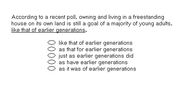
According to a recent poll, owning and living in a freestanding house on its own land is still a goal of a majority of young adults, like that of earlier generations.
So, the first part of the sentence tells us something that has been discovered through the results of a recent poll. The sentence then talks about 'owning and living in a freestanding house on its own land'. This is a goal of many young adults.
Then the author introduces a comparison using the word 'like'. As we already know, 'like' should only be used to compare nouns. After 'like', we have the phrase 'that of earlier generations'. So what does 'that' stand for?
To understand this, let's look at a couple of
examples:
1: Sara has many friends like her sister.
2: Sara has many friends, like her sister. (This sentence can also be written as: Like her sister, Sara has many friends.)
In the first sentence, there is no comma before 'like'. So, the comparison is between 'friends' and 'sister'. The sentence means that Sara has many friends who are like her sister.
In the second sentence, there is a comma before 'like'. In such a construction, the noun after 'like' is compared with the subject of the previous clause. So, the comparison in this case is between Sara and her sister. The sentence means that both Sara and her sister have many friends.
Now let's apply this rule to the question. In this sentence, there is a comma before 'like'. So, the noun after 'like' is compared with the subject of the previous clause, which is 'owning and living in a freestanding house on its own land'.
In fact if you would like to learn more about the correct and incorrect uses of Like, simply register at
e-GMAT and access the free trial for Sentence Correction that includes this concept.
So, as it stands, the sentence means:
According to a recent poll, owning and living in a freestanding house on its own land is still a goal of a majority of young adults, like owning and living in a freestanding house on its own land of earlier generations.
Clearly,
this makes no sense. For more information and examples about how to use 'as' and 'like' for comparisons, do check out our concept files on this topic by registering for a free trial at e-GMAT.
So, what's the intended meaning of the sentence? The intended meaning can be inferred from the original sentence, even if the original sentence is not framed correctly. The author intends to compare two things; let's call them X and Y.
X: Something is still a goal of a majority of young adults.
Y: The same 'something' was a goal of earlier generations.
To summarize the sentence, the author says that a majority of young adults have the goal of owning and living in an independent house, as earlier generations also did.
Now, when we apply this understanding to the structure of the original sentence, we find that something is missing in the comparison presented in the original sentence. We know the intended comparison: something was a goal in the past, and is still a goal in the present. Note that this comparison between something in the past and something in the present is indicated using the verbs "is" and "was". Something WAS a goal in the past. Something IS still a goal now. The author intends to compare two actions, one in the past and one in the present. However, the original sentence has no parallel for the verb 'is'. Going back to our X and Y elements, let's identify the parallel items in each of the two:
X: Something is still a goal of a majority of young adults.
Y: The same 'something' was a goal of earlier generations.
1. Something (owning and living in a freestanding house on its own land) || something (that)
2. Is || was
3. Goal of a majority of young adults || a goal of earlier generations
As you can see, the original sentence has no parallel verb for 'is'. The comparison error can be resolved by introducing the verb 'was' to parallel the verb 'is', thus clarifying the meaning of the sentence. Option E does so perfectly by presenting the comparison in the form of 'as'+clause. In option E, 'it' correctly refers to the goal and 'was' correctly parallels 'is'.
I hope this helps!
Regards,
Meghna