Hello,
Can you please assist with this question? This is from MGMAT:
OA: D
Thanks for your help.
Can you please assist with this question? This is from MGMAT:
OA: D
Thanks for your help.
- Attachments
-
BREAKING: Target Test Prep releases Brand New 2026 On Demand GMAT prep course
RedeemTarget Test Prep · GMAT
Learn live with an expert or move at your own pace. Every option includes the complete TTP study system.

with Chris Peckover


with Logan Thompson
Complete access from day one. Study on your schedule.
Compare the format, schedule, and included access before enrolling. Prices and seat counts shown reflect the supplied offer details.

Many slope questions can be solved efficiently by DRAWING.If line L in the xy-coordinate plane has a positive slope, what is the x-intercept of L ?
(1) There are different points (a, b) and (c, d) on line L such that ad = bc.
(2) There are constants m and n such that the points (m, n) and (-m, -n) are both on line L

GMATGuruNY wrote:Many slope questions can be solved efficiently by DRAWING.If line L in the xy-coordinate plane has a positive slope, what is the x-intercept of L ?
(1) There are different points (a, b) and (c, d) on line L such that ad = bc.
(2) There are constants m and n such that the points (m, n) and (-m, -n) are both on line L
Statement 1: There are different points (a, b) and (c, d) on line L such that ad = bc.
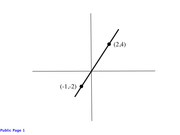
Case 1: a=-1, d=4, b=-2, c=2
Here, line L contains (a,b) = (-1,-2) and (c,d) = (2,4):
Since line L passes through the origin, its x-intercept is 0.
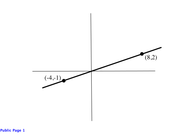
Case 2: a=-4, d=2, b=-1, c=8
Here, line L contains (a,b) = (-4,-1) and (c,d) = (8,2):
Since line L passes through the origin, its x-intercept is 0.
The two random cases above illustrate that -- when ad=bc -- line L must pass through the origin and thus will have an x-intercept of 0.
SUFFICIENT.
Statement 2: There are constants m and n such that the points (m, n) and (-m, -n) are both on line L
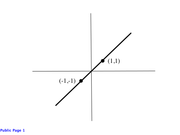
Case 3: m=1 and n=1
Here, line L contains (m,n) = (1,1) and (-m,-n) = (-1,-1):
Since line L passes through the origin, its x-intercept is 0.
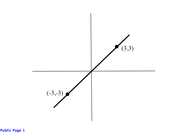
Case 4: m=-3, n=-3
Here, line L contains (m,n) = (-3,-3) and (-m,-n) = (3,3):
Since line L passes through the origin, its x-intercept is 0.
The two random cases above illustrate that -- since Line L contains both (m,n) and (-m,-n) -- it must pass through the origin and thus will have an x-intercept of 0.
SUFFICIENT.
The correct answer is D.

GMATGuruNY wrote:Mitch,
Statement 1: There are different points (a, b) and (c, d) on line L such that ad = bc.
Case 1: a=-1, d=4, b=-2, c=2
Here, line L contains (a,b) = (-1,-2) and (c,d) = (2,4):
Since line L passes through the origin, its x-intercept is 0.
Case 2: a=-4, d=2, b=-1, c=8
Here, line L contains (a,b) = (-4,-1) and (c,d) = (8,2):
Since line L passes through the origin, its x-intercept is 0.
The two random cases above illustrate that -- when ad=bc -- line L must pass through the origin and thus will have an x-intercept of 0.
SUFFICIENT.
.
For evaluating Statement 1 - How would you know that the line passes through the origin? You would have to find that out using equation of a line which you havent mentioned in your solution.
Connect (-1,-2) and (2.4), and you get a line that passes through the origin.faraz_jeddah wrote:
For evaluating Statement 1 - How would you know that the line passes through the origin? You would have to find that out using equation of a line which you havent mentioned in your solution.
Dont you think that would leave chance for an error? I mean I just drew a rough graph and I cannot be 100% sure that the x int would be 0. It appears as 0.5 as my grids are not accurate.GMATGuruNY wrote:Connect (-1,-2) and (2.4), and you get a line that passes through the origin.faraz_jeddah wrote:
For evaluating Statement 1 - How would you know that the line passes through the origin? You would have to find that out using equation of a line which you havent mentioned in your solution.
Connect (-4,-1) and (8,2), and you get a line that passes through the origin.
There is no need to determine the equation of either line.
Even a rudimentary drawing should be sufficient to see that (a.b) and (c,d) exhibit SYMMETRY about the origin.faraz_jeddah wrote:Dont you think that would leave chance for an error? I mean I just drew a rough graph and I cannot be 100% sure that the x int would be 0. It appears as 0.5 as my grids are not accurate.GMATGuruNY wrote:Connect (-1,-2) and (2.4), and you get a line that passes through the origin.faraz_jeddah wrote:
For evaluating Statement 1 - How would you know that the line passes through the origin? You would have to find that out using equation of a line which you havent mentioned in your solution.
Connect (-4,-1) and (8,2), and you get a line that passes through the origin.
There is no need to determine the equation of either line.
Hello Mitch,GMATGuruNY wrote:Many slope questions can be solved efficiently by DRAWING.If line L in the xy-coordinate plane has a positive slope, what is the x-intercept of L ?
(1) There are different points (a, b) and (c, d) on line L such that ad = bc.
(2) There are constants m and n such that the points (m, n) and (-m, -n) are both on line L
Statement 1: There are different points (a, b) and (c, d) on line L such that ad = bc.
Case 1: a=-1, d=4, b=-2, c=2
Here, line L contains (a,b) = (-1,-2) and (c,d) = (2,4):
Since line L passes through the origin, its x-intercept is 0.
Case 2: a=-4, d=2, b=-1, c=8
Here, line L contains (a,b) = (-4,-1) and (c,d) = (8,2):
Since line L passes through the origin, its x-intercept is 0.
The two random cases above illustrate that -- when ad=bc -- line L must pass through the origin and thus will have an x-intercept of 0.
SUFFICIENT.
Statement 2: There are constants m and n such that the points (m, n) and (-m, -n) are both on line L
Case 3: m=1 and n=1
Here, line L contains (m,n) = (1,1) and (-m,-n) = (-1,-1):
Since line L passes through the origin, its x-intercept is 0.
Case 4: m=-3, n=-3
Here, line L contains (m,n) = (-3,-3) and (-m,-n) = (3,3):
Since line L passes through the origin, its x-intercept is 0.
The two random cases above illustrate that -- since Line L contains both (m,n) and (-m,-n) -- it must pass through the origin and thus will have an x-intercept of 0.
SUFFICIENT.
The correct answer is D.
New here Create free account




















