Compound Interest

This topic has expert replies
Newbie | Next Rank: 10 Posts
Posts: 7
Joined: Sat Aug 04, 2012 6:42 am

Compound Interest

by ras-j » Sat Oct 06, 2012 1:21 am
Donald plans to invest x dollars in a savings account that pays interest at an annual rate of 8% compounded quarterly. Approximately what amount is the minimum that Donald will need to invest to earn over $100 in interest within 6 months?


A. $1500
B. $1750
C. $2000
D. $2500
E. $3000
If interest rate for 6 months will be 4% then how x is 2500?
Source: — Problem Solving |

User avatar
GMAT Instructor
Posts: 15539
Joined: Tue May 25, 2010 12:04 pm
Location: New York, NY
Thanked: 13060 times
Followed by:1906 members
GMAT Score:790

by GMATGuruNY » Sat Oct 06, 2012 3:20 am
ras-j wrote:Donald plans to invest x dollars in a savings account that pays interest at an annual rate of 8% compounded quarterly. Approximately what amount is the minimum that Donald will need to invest to earn over $100 in interest within 6 months?


A. $1500
B. $1750
C. $2000
D. $2500
E. $3000
We can plug in the answers, which represent the minimum amount that must be invested to earn $100 over 2 quarters.

8% interest compounded quarterly means:
In the first quarter, the interest = 2% of the initial investment.
In the second quarter, the interest = 2% of the amount at the end of the first quarter.
The result is that the COMPOUNDED interest will be equal to JUST A BIT MORE than 4%.

Answer choice C: 2000
(4/100)2000 = 80.
Too small.

Answer choice D: 2500
(4/100)2500 = 100.
Thus, the COMPOUNDED interest will be JUST A BIT MORE than 100.
Success!

The correct answer is D.
Private tutor exclusively for the GMAT and GRE, with over 20 years of experience.
Followed here and elsewhere by over 1900 test-takers.
I have worked with students based in the US, Australia, Taiwan, China, Tajikistan, Kuwait, Saudi Arabia -- a long list of countries.
My students have been admitted to HBS, CBS, Tuck, Yale, Stern, Fuqua -- a long list of top programs.

As a tutor, I don't simply teach you how I would approach problems.
I unlock the best way for YOU to solve problems.

For more information, please email me (Mitch Hunt) at [email protected].
Student Review #1
Student Review #2
Student Review #3

GMAT/MBA Expert

User avatar
GMAT Instructor
Posts: 273
Joined: Tue Sep 21, 2010 5:37 am
Location: Durham, NC
Thanked: 154 times
Followed by:74 members
GMAT Score:770

by Whitney Garner » Tue Oct 09, 2012 11:21 am
ras-j wrote:Donald plans to invest x dollars in a savings account that pays interest at an annual rate of 8% compounded quarterly. Approximately what amount is the minimum that Donald will need to invest to earn over $100 in interest within 6 months?


A. $1500
B. $1750
C. $2000
D. $2500
E. $3000
If interest rate for 6 months will be 4% then how x is 2500?
Hi ras-j!

You can also solve this using the compound interest formula:
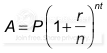
Image

where:
A = Final Value
P = Initial Investment
r = interest rate (as a decimal)
n = # times compounded per year
t = # of years

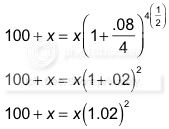
Here the initial is unknown, so I'll call it X. Since we want to earn $100, that would be X+100. The rate is .08, the # of times is quarterly, so 4, and we have 6 months or 1/2 of a year.

A = 100+X
P = X
r = .08
n = 4
t = 1/2

plug this in and solve for X (and don't forget to approximate!!)
Image
Now when I multiply 1.02 times 1.02, I actually get 1.0404, but I'm approximating, so I'm rounding to 1.04. That gives us:

100 + x = 1.04x
100 = 0.04x
10000 = 4x
x = 2500.

**NOTE: You can actually think of this formula a bit more simply. Notice that the compounding factor (the +.02) isn't the same as the annual rate. That is because we compound more than once a year. This is actually the same with your credit cards. If you have an annual rate of say 12% but it is compounded monthly. Then each month, you aren't charged 12% (that would end up being HUGE), you're only charged 12%/12 mos, so 1% each month.

So, that means that you can write the formula as

A = P (1+ rate at each compound) ^ (number of times I'll need to compound)

This might make it easier, since 8% compounded quarterly would be 2% each time, and I will only have 2 compounds in a 6 month period, I can immediately write:

A = P(1.02)^2

Hope this Helps!
:)
Whit
Whitney Garner
GMAT/GRE/EA Instructor & Anxiety/Accommodations Coach
www.whitneygarner.com

Contributor to Beat The GMAT!

Math is a lot like love - a simple idea that can easily get complicated :heart-eyes:



















