
BREAKING: Target Test Prep releases Brand New 2026 On Demand GMAT prep course

Redeem

Target Test Prep · GMAT

Choose how you want to prepare

Learn live with an expert or move at your own pace. Every option includes the complete TTP study system.

★★★★★5.0559 reviews
GMATLiveTeach 7 seats left
Chris Peckover
NEXT LIVE COHORT

Oct 13 to Jan 7, 2027

with Chris Peckover

Schedule
Tue, Thu · 8:00 to 10:00 PM ET
Included
40 live hours + 6 months of GMAT OnDemand
  • Live instruction and real-time questions
  • Class recordings and assigned practice
View class & enroll
Limited cohort · enrollment openTarget Test Prep
EALiveTeach 5 seats left
Logan Thompson
EXECUTIVE ASSESSMENT

Sep 6 to Dec 6, 2026

with Logan Thompson

Schedule
Sun · 9:30 AM to 12:30 PM ET
Included
40 hours of live online classes plus six months of access to the complete TTP EA OnDemand course.
  • 165+ EA Score Guarantee
  • 4,100+ Quant, Verbal, and Integrated Reasoning practice questions
  • 400+ hours of in-depth video lessons
  • 3,000+ step-by-step video solutions
View EA class & enroll
Limited cohort · enrollment openTarget Test Prep
GMATOnDemand Start anytime
SELF-PACED MASTERCLASS

Target Test Prep GMAT OnDemand

Complete access from day one. Study on your schedule.

715+ score guarantee
$0to start then $127/mo
  • Personalized study plan and analytics
  • Thousands of lessons and practice questions

Compare the format, schedule, and included access before enrolling. Prices and seat counts shown reflect the supplied offer details.

Negative Values

Problem Solving — algebra and arithmetic (GMAT Focus Edition)
Expert replies
by kamalakarthi » Mon Aug 07, 2017 10:51 am
Hi,

This is from MCAT test.

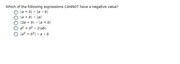
In this below question, I got to the right answer after testing for various numbers. But I took long time to solve this question.
How can I improve my choosing the right numbers.

I tried with a=5 and b=3 then I tried with A=1 and B=-1 then I tried with A=-2 and B=-3


Image
Join the discussion
Source: — Quantitative Reasoning |

by [email protected] » Mon Aug 07, 2017 3:34 pm
Hi kamalakarthi,

In certain circumstance - when TESTing VALUES - it's sometimes best to 'target' a particular answer and try to select values that will directly eliminate it (as opposed to randomly selecting values and seeing what happens).

With these answer choices, it also helps to break each answer into 2 parts: the first absolute value and whatever is subtracted from it.

For Answers A, B and C, you should look to make the first part equal 0 and the second part NOT 0....
Answer A: A = 1, B = -1 ... |1 - 1| - |1 - (-1)| = 0 - 2 = -2 Eliminate Answer A.

Answer B: A = 1, B = -1 .... |1 - 1| - |1| = 0 - 1 = -1 Eliminate Answer B.

Answer C: A = 1, B = -2.... |2 - 2| - |1 -2| = 0 - 1 = -1 Eliminate Answer C.

For the remaining two answers, since you're dealing with exponents, you should consider fractions....

Answer E: A = 1/2, B = 1/2 ... |(1/2)^3 + (1/2)^3| - 1/2 - 1/2 = 2/8 - 1 = -6/8 Eliminate Answer E.

Final Answer: D

GMAT assassins aren't born, they're made,
Rich
Contact Rich at [email protected]
Image
Join the discussion

by Matt@VeritasPrep » Fri Aug 18, 2017 1:12 pm
If you try numbers, remember that you don't have to try each answer every time! Once you get a negative result for an answer, that answer is eliminated, and you only have to doubletest the answers that showed positive.
Join the discussion

by Matt@VeritasPrep » Fri Aug 18, 2017 1:13 pm
Let me add a (semi-)algebraic approach too.

Suppose that each answer is negative. For instance, for answer B that would give us

|a + b| - |a| < 0, or

|a + b| < |a|

This is obviously possible, if a = 3 and b = -1, so a negative result could work here.

Continuing this way through the other answers, you might find plugging in faster and simpler.
Join the discussion

by Matt@VeritasPrep » Fri Aug 18, 2017 1:18 pm
We could take a conceptual approach too. Remembering that |x - y| = the distance from x to y on the number line, we could say

A::
|a + b| - |a - b| < 0
|a + b| < |a - b|
the distance from a to -b < the distance from a to b

This is definitely possible.

B::

|a + b| < |a|
the distance from a to -b < the distance from a to 0

Also totally possible!

C::

|2a + b| < |a + b|
the distance from 2a to -b < the distance from a to -b

Yup, works!

D::

a² - 2|ab| + b² < 0

(|a| - |b|)² < 0

Aha! No such thing as a negative square - at least not in GMAT math - so we've found our answer.
Join the discussion


















