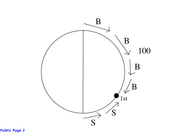
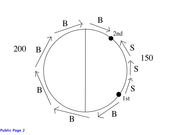
[email protected] wrote:Brenda and Sally run in opposite direction on a circular track, starting at diametrically opposite points. They first meet after Brenda has run 100 meters. They next meet after Sally has run 150 meters past their first meeting point. Each girl runs at a constant speed. What is the length of the track in meters?
A. 250
B. 300
C. 350
D. 400
E. 500
Hi! This seems like a somewhat insanely complicated question! However, our old friend backsolving will save us from having to do crazy math.
First, "diametrically opposed" means, literally, "at opposite ends of a diameter of the circle". In other words, they're directly across the circle from each other. Thinking geometrically, if one of the two starts at 0 degrees, the other starts at 180 degrees.
You could set up some pretty complicated equations to solve this problem, but backsolving will be much quicker. Since there's no quick reason to eliminate choices based on logic, let's start with (B).
If the distance were 300, then since they run in opposite directions (i.e. directly toward each other), they'll have jointly covered 150m when they meet. We're told that Brenda has run 100m at this time, which means that S has only covered 50m.
They next meet after S covers 150m. Well, if the track were 300m long, then that means that B has also covered 150m (they meet after jointly running 1 full circle). However, we know that B is faster than S (since B covered 100 to S's 50 in the first part), so that makes no sense! (B)300 is too small.
Next let's try (D)400. If the total distance is 400, then the first meet after 200m. B has run 100m, which means that S has also run 100 - so they have to be running at the same speed. They next meet when S has run 150m.. but wait, that's not 1/2 of 400, that makes no sense! So, (D) goes too far in the opposite direction.
(B) is too small, (D) is too big - breathe a sigh of relief and choose (C)!
Again, this is a VERY high level Q.
* * *
Now, what should you do when you're done the question and reviewing? Practice! So, even though on test day we'd pick (C) and move on, let's actually backsolve (C) just to make sure we know how to backsolve properly.
If d=350, then 1/2d = 175. So, when they meet the first time B has gone 100 and S has gone 75.
They meet again after S runs 150, which means that B runs 350-150=200.
The first time, B ran 100 and S ran 75... that's a 100:75 ratio.
The second time, B ran 200 and S ran 150... that's also a 100:75 ratio.
Since the ratios are the same both times, (C) is in fact the correct answer.