gmat_guy666 wrote:An isosceles right triangle with a leg of length "a" and perimeter "p" is further divided into two similar triangles of equal area. Which of the following represents the perimeter of one of these smaller triangles?
A. p/2
B. p−a
C. (p+a)/2
D. 2a
E. p-a* root2
OAB
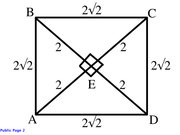
In square ABCD, ∆ABE is 1/2 of isosceles right triangle ∆ABD.
∆ABE:
As the figure shows, ∆ABE is itself an isosceles right triangle.
The sides of an isosceles triangle are in the following ratio:
x : x : x√2.
Let AE=2, BE=2, and AB = 2√2.
∆ABD:
a = the length of each leg = 2√2.
p = 2√2 + 2√2 + 2 + 2 = 4 + 4√2.
The question stem asks for the perimeter of ∆ABE.
The perimeter of ∆ABE = 2 + 2 + 2√2 = 4 + 2√2. This is our target.
Now plug into the answers a = 2√2 and p = 4 + 4√2 to see which answer yields our target of 4 + 2√2.
Only
B works:
p-a = (4 + 4√2) - 2√2 = 4 + 2√2.
The correct answer is
B.
Private tutor exclusively for the GMAT and GRE, with over 20 years of experience.
Followed here and elsewhere by over 1900 test-takers.
I have worked with students based in the US, Australia, Taiwan, China, Tajikistan, Kuwait, Saudi Arabia -- a long list of countries.
My students have been admitted to HBS, CBS, Tuck, Yale, Stern, Fuqua -- a long list of top programs.
As a tutor, I don't simply teach you how I would approach problems.
I unlock the best way for YOU to solve problems.
For more information, please email me (Mitch Hunt) at
[email protected].
Student Review #1
Student Review #2
Student Review #3























