BREAKING: Target Test Prep releases Brand New 2026 On Demand GMAT prep course

Redeem

Speed Distance Time /Proportion

Expert replies
by raj44 » Tue Aug 19, 2014 8:59 pm
Jim takes a seconds to swim c meters at a constant rate from point P to point Q in a pool. Roger, who is faster than Jim, can swim the same distance in b seconds at a constant rate. If Jim leaves point P the same time that Roger leaves point Q, how many fewer meters will Jim have swum than Roger when the two swimmers pass each other?

1. c(b-a)/a+b
2. c(a-b)/a+b
3. c(a+b)/a-b
4. ab(a-b)/a+b
5. ab(b-a)/a+b

OA 2
Join the discussion
Source: — Problem Solving |

by GMATGuruNY » Wed Aug 20, 2014 2:29 am
Jim takes a seconds to swim c meters at a constant rate from point P to point Q in a pool. Roger, who is faster than Jim, can swim the same distance in b seconds at a constant rate. If Jim leaves point P the same time that Roger leaves point Q, how many fewer meters will Jim have swum than Roger when the two swimmers pass each other?


A) c(b-a)/ a+b
B) c(a-b)/a+b
C) c(a+b)/a-b
D) ab(a-b)/a+b
E) ab(b-a)/a+b
Since there are variables in the answer choices, we can plug in values.

Let c = 30 meters, a = 3 seconds, and b = 2 seconds.

Jim's rate = d/t = 30/3 = 10 meters per second.
Roger's rate = d/t = 30/2 = 15 meters per second.

Jim's rate : Roger's rate = 10:15 = 2:3 = 12:18.
Implication: for every 12 meters that Jim swims, Roger swims 18 meters.
Thus, when the two travel the 30 meters between them, Roger's distance - Jim's distance = 18-12 = 6 meters. This is our target.

Now we plug c=30, a=3 and b=2 into the answers to see which yields our target of 6.
Only B works:
c(a-b)/(a+b) = 30(3-2)/(3+2) = 6.

The correct answer is B.
Private tutor exclusively for the GMAT and GRE, with over 20 years of experience.
Followed here and elsewhere by over 1900 test-takers.
I have worked with students based in the US, Australia, Taiwan, China, Tajikistan, Kuwait, Saudi Arabia -- a long list of countries.
My students have been admitted to HBS, CBS, Tuck, Yale, Stern, Fuqua -- a long list of top programs.

As a tutor, I don't simply teach you how I would approach problems.
I unlock the best way for YOU to solve problems.

For more information, please email me (Mitch Hunt) at [email protected].
Student Review #1
Student Review #2
Student Review #3

Join the discussion

by j_shreyans » Wed Aug 20, 2014 3:21 am
Hi ,

How come 12:18?
Join the discussion

by raj44 » Wed Aug 20, 2014 4:44 am
Thanks guru !

I was able to eliminate options D and E based on Dimensional Analysis (D and E ruled out since we need the distance, whereas D and E are missing variable C)..Any trick to figure out the incorrect option among A,B,C using some diff. approach?

GMATGuruNY wrote:
Jim takes a seconds to swim c meters at a constant rate from point P to point Q in a pool. Roger, who is faster than Jim, can swim the same distance in b seconds at a constant rate. If Jim leaves point P the same time that Roger leaves point Q, how many fewer meters will Jim have swum than Roger when the two swimmers pass each other?


A) c(b-a)/ a+b
B) c(a-b)/a+b
C) c(a+b)/a-b
D) ab(a-b)/a+b
E) ab(b-a)/a+b
Since there are variables in the answer choices, we can plug in values.

Let c = 30 meters, a = 3 seconds, and b = 2 seconds.

Jim's rate = d/t = 30/3 = 10 meters per second.
Roger's rate = d/t = 30/2 = 15 meters per second.

Jim's rate : Roger's rate = 10:15 = 2:3 = 12:18.
Implication: for every 12 meters that Jim swims, Roger swims 18 meters.
Thus, when the two travel the 30 meters between them, Roger's distance - Jim's distance = 18-12 = 6 meters. This is our target.

Now we plug c=30, a=3 and b=2 into the answers to see which yields our target of 6.
Only B works:
c(a-b)/(a+b) = 30(3-2)/(3+2) = 6.

The correct answer is B.
Join the discussion

by Katy_ » Wed Aug 20, 2014 4:51 am
raj44 wrote:Jim takes a seconds to swim c meters at a constant rate from point P to point Q in a pool. Roger, who is faster than Jim, can swim the same distance in b seconds at a constant rate. If Jim leaves point P the same time that Roger leaves point Q, how many fewer meters will Jim have swum than Roger when the two swimmers pass each other?

1. c(b-a)/a+b
2. c(a-b)/a+b
3. c(a+b)/a-b
4. ab(a-b)/a+b
5. ab(b-a)/a+b

OA 2
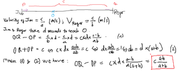
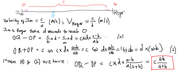
Image
Image
Join the discussion

by spark » Tue Mar 15, 2016 2:53 pm
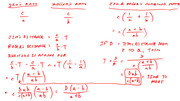
This problem contains an error. As written, the problem does not specify that the distance from P to Q is c meters. Intuitively, the total distance from P to Q should matter, and in fact it does.

The wording of the problem could be fixed by changing the first sentence to: "Swimming at a constant rate, Jim takes a seconds to cover the c meters from point P to point Q in a pool." If the problem were worded this way, the official solution and the other solutions posted here would be correct.

The number picking approach used in the official solution conveniently assumes that the distance from P to Q is c meters, so that's why this approach works. If any other distance were selected, the official answer would not work.

As the problem is currently worded, the correct answer should be D(a - b) / (a + b), where D is the distance from P to Q.

See the attached for a detailed solution.
Image
Stuart Park
Simply Brilliant
Stuart is a Harvard grad GMAT expert who scored 760 the first time he took the exam, with 99th percentile quant and verbal scores. He has extensive experience teaching for one of the "elite" GMAT prep companies. Through https://www.simplybrilliantprep.com he offers online classes, private tutoring and MBA application consulting for clients worldwide.
Join the discussion