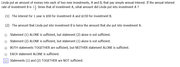
Linda put an amount of money into each of two new investments, that pay simple annual interest. If the annual rate of investment B is 1.5 times that of investment A, what amount did Linda put into investment A?
1) The interest for 1 year is $50 for investment A and $150 for investment B.
2) The amount that Linda put in investment B is twice the amount she put in investment A.
The following cases satisfy the constraint that B's interest rate is 1.5 times A's interest rate:
Case 1: A = 100% interest, B = 150% interest
Case 2: A = 200% interest, B = 300% interest
To evaluate the statements, test both cases.
Statement 1: The interest for 1 year is $50 for investment A and $150 for investment B.
Case 1: 100% interest, B = 150% interest
Since A's interest ($50) is equal to 100% of the initial investment, the amount invested in A = $50.
Since B's interest ($150) is equal to 1.5 times the initial investment, the amount invested in B = $100.
Case 2: A = 200% interest, B = 300% interest
Since A's interest ($50) is equal to 200% of the initial investment, the amount invested in A = $25.
Since B's interest ($150) is equal to 3 times the initial investment, the amount invested in B = $50.
Since the amount invested in A is $50 in Case 1 but $25 in Case 2, INSUFFICIENT.
Both Case 1 and Case 2 also satisfy statement 2:
In each case, the amount invested in B is twice that invested in A.
Thus, when the two statements are combined, the amount invested in A could be $50 or $25.
INSUFFICIENT.
The correct answer is
E.
Private tutor exclusively for the GMAT and GRE, with over 20 years of experience.
Followed here and elsewhere by over 1900 test-takers.
I have worked with students based in the US, Australia, Taiwan, China, Tajikistan, Kuwait, Saudi Arabia -- a long list of countries.
My students have been admitted to HBS, CBS, Tuck, Yale, Stern, Fuqua -- a long list of top programs.
As a tutor, I don't simply teach you how I would approach problems.
I unlock the best way for YOU to solve problems.
For more information, please email me (Mitch Hunt) at
[email protected].
Student Review #1
Student Review #2
Student Review #3