You pose an interesting question, "how to solve?" but remember this is a DS question, so our job is not to solve, simply to determine whether a statement is sufficient TO solve.

It's some comfort that we don't actually have to DO the hard work on DS.
That said, here's how I'd break it down:
This is a VALUE question. We want to know # of residents who DO NOT own a VCR or DVD. The givens:
-4,500 residents = VCR, DVD, or both
A matrix is best used when we have multiple categories with choices WITHIN each category. For example, if this question was Residents/Non-Residents in addition to VCR/DVD, then a double-set matrix would be a smart choice. But because we're only looking at VCR/DVD + an overlap, so a Venn Diagram is a better option if you're looking to express the givens in a visual format.
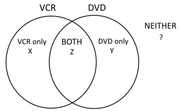
This VALUE question is asking us the value of the question-mark. We need to know the TOTAL residents so we could subtract the 4,200 to identify the number of residents who are OUTSIDE the Venn.
Now we can analyze the statements:
1) This says that X + Y = 4,200, but without knowing the total residents in Reytown and the value of Z ("both"), we cannot find the value of "Neither." Insufficient.
2) This tells us 10% own neither, and we know that 4,500 = X + Y + Z. So that 4,500 must equal 90% of the total.
4,500 = .9(T)
Sufficient.
Here's a problem in which a matrix would be useful:
33 out of the 47 students in an advanced degree program have a higher than average GPA. How many students in the program are receiving some form of academic scholarship?
(1) More students do not have a scholarship than have a scholarship.
(2) The same number of students have a higher than average GPA and are receiving some form of academic scholarship as have neither a higher than average GPA nor an academic scholarship.
Solution:
From the question-stem, we know 33 students have a high GPA, while 14 do not. We need more information about which of these students have scholarships to be able to answer this value question. Notice how the categories are more complicated in this question than in the previous question, since we've got higher than average/lower than average and earning a scholarship/not earning a scholarship.
Statement (1) is insufficient because it does not give us information to find the exact numerical value of the students receiving some form of scholarship.
Statement (2) tells us that the number of students who fit "both" is equal to the number of students who fit "neither." Let's set up a chart to visualize the four possible categories for the students. Since "both" = "neither," let's fill in "x" for those boxes.
The key to the double-set matrix is to make sure you have a vertical and a horizontal "TOTAL" column:

Since each column and row must total, if there are "x" students receiving no scholarship and not a higher GPA, and the total students who don't have a higher GPA is 14, then 14-x students must not have a higher GPA and have a scholarship. The total we are looking for is represented by the red "?," and we can set up an equation to solve: x + (14 - x) = 14. Sufficient. The answer is [spoiler](B)[/spoiler].
Hope this helps!
Best,
Vivian























