Hi All,
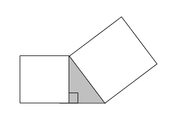
We're told that the two squares have areas 16 and 25, respectively. We're asked for the AREA of the shaded triangular region. This is an example of how the GMAT writers sometimes like to 'hide' the special Right Triangles (re: 3/4/5, 5/12/13, 30/60/90 and 45/45/90) in Geometry questions - and if you recognize the patterns involved, then you can answer this question relatively quickly without too much work.
To start, based on the areas of the two squares, we know that their respective sides are 4s and 5s. Thus, the right triangle has a height of 4 and a hypotenuse of 5. You probably recognize this as a 3/4/5 right triangle, but even if you didn't, you can use the Pythagorean Theorem to prove it:
A^2 + B^2 = C^2
A^2 + 4^2 = 5^2
A^2 + 16 = 25
A^2 = 9
A = 3... since this is a shape, it can't have a "negative" side (so -3 is not an option).
With a height of 4 and a base of 3, we can determine the AREA of the shape:
A = (1/2)(base)(height)
A = (1/2)(3)(4)
A = 6
Final Answer: A
GMAT assassins aren't born, they're made,
Rich