BREAKING: Target Test Prep releases Brand New 2026 On Demand GMAT prep course

Redeem

red ball_prep

Expert replies
Source: — Data Sufficiency |

by perwinsharma » Sat Jul 26, 2014 11:50 pm
Here we know, that all the variables B, R, and W are positive.

1) R/(B + W) > W/(B + R)
If we cross multiply
RB + R^2 > WB + W^2
=> (R^2 - W^2) + (RB - WB) > 0
=> (R + W) (R - W) + B(R - W) > 0
=> (R- W) (B + R + W) > 0
=> We know that B + R + W > 0 as all the variables are positive
=> R - W has to be more than zero
=> R > W
SUFFICIENT

2) B - W > R
Doesn't give us any information.

The answer is (A).


Praveen Sharma
Veritas Prep GURGAON
Praveen Sharma
Wizius Careers
Gurgaon
India
https://www.facebook.com/wiziuscareergmat/
Join the discussion

by GMATGuruNY » Sun Jul 27, 2014 2:32 am
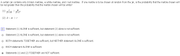
A certain jar contains only b black marbles, w white marbles and r red marbles. If one marble is to be chosen at random from the jar, is the probability that the marble chosen will be red greater then the probability that the marble chosen will be white?

(1) r/(b+w) > w/(b+r)
(2) b-w > r
Very little math is needed here.
Just use common sense.

Question stem, rephrased: Is R>W?

Statement 1: r/(b+w) > w/(b+r)
Put into words:
The ratio of R to the OTHER marbles is greater than the ratio of W to the OTHER marbles.
The statement above can be true only if THERE ARE MORE RED MARBLES THAN WHITE MARBLES.
Thus, R>W.
SUFFICIENT.

Statement 2: b-w > r
B > R+W.
No way to determine whether R>W.
INSUFFICIENT.

The correct answer is A.
Last edited by GMATGuruNY on Sun Jul 27, 2014 3:24 am, edited 1 time in total.
Private tutor exclusively for the GMAT and GRE, with over 20 years of experience.
Followed here and elsewhere by over 1900 test-takers.
I have worked with students based in the US, Australia, Taiwan, China, Tajikistan, Kuwait, Saudi Arabia -- a long list of countries.
My students have been admitted to HBS, CBS, Tuck, Yale, Stern, Fuqua -- a long list of top programs.

As a tutor, I don't simply teach you how I would approach problems.
I unlock the best way for YOU to solve problems.

For more information, please email me (Mitch Hunt) at [email protected].
Student Review #1
Student Review #2
Student Review #3
Join the discussion

by GMATGuruNY » Sun Jul 27, 2014 2:45 am
Another way to evaluate statement 1.

Statement 1: r/(b+w) > w/(b+r)
Test whether it's possible that R=W or that R<W.

Case 1: R=W=1
Substituting R=1 and W=1 into r/(b+w) > w/(b+r), we get:
1/(b+1) > 1/(b+1)
b+1 > b+1
0 > 0.
Doesn't work.
Case 1 illustrates that R=W is not viable.

Case 2: R=1 and W=2
Substituting R=1 and W=2 into r/(b+w) > w/(b+r), we get:
1/(b+2) > 2/(b+1)
b+1 > 2b + 4
-b > 3
b < -3.
Not possible: b must be a positive value.
Case 2 illustrates that R<W is not viable.

Since it's not possible that R=W or that R<W, it must be true that R>W.
SUFFICIENT.
Private tutor exclusively for the GMAT and GRE, with over 20 years of experience.
Followed here and elsewhere by over 1900 test-takers.
I have worked with students based in the US, Australia, Taiwan, China, Tajikistan, Kuwait, Saudi Arabia -- a long list of countries.
My students have been admitted to HBS, CBS, Tuck, Yale, Stern, Fuqua -- a long list of top programs.

As a tutor, I don't simply teach you how I would approach problems.
I unlock the best way for YOU to solve problems.

For more information, please email me (Mitch Hunt) at [email protected].
Student Review #1
Student Review #2
Student Review #3
Join the discussion

by GMATinsight » Sun Jul 27, 2014 9:57 am
A certain jar contains only b black marbles, w white marbles and r red marbles. If one marble is to be chosen at random from the jar, is the probability that the marble chosen will be red greater then the probability that the marble chosen will be white?

(1) r/(b+w) > w/(b+r)
(2) b-w > r
Probability of Red marble picked = r/(b+w+r)
Probability of White marble picked = w/(b+w+r)

Question : Is r/(b+w+r) > w/(b+w+r)

Question Rephrased : Is r > w ?

Statement 1) r/(b+w) > w/(b+r)
i.e. r(b+r) > w(b+w)
i.e. rb + r^2 > wb + w^2
i.e. rb - wb > w^2 - r^2
i.e. b(r - w) > (w - r)(w + r)
i.e. 0 > (w - r)(w + r) - b(r - w)
i.e. 0 > (w - r)(w + r) + b(w - r)
i.e. 0 > (w - r)(w + r + b)
BUT (w + r + b) is definitely Greater than Zero
Therefore, (w-r) is certainly Negative
i.e. w-r < 0
i.e. w < r
SUFFICIENT

Statement 2) b-w > r
Due to b being present in the above expression, w and r can't be compared, therefore
INSUFFICIENT

Answer: Option A
"GMATinsight"Bhoopendra Singh & Sushma Jha
Most Comprehensive and Affordable Video Course 2000+ CONCEPT Videos and Video Solutions
Whatsapp/Mobile: +91-9999687183 l [email protected]
Contact for One-on-One FREE ONLINE DEMO Class Call/e-mail
Most Efficient and affordable One-On-One Private tutoring fee - US$40-50 per hour
Join the discussion

by Brent@GMATPrepNow » Sun Jul 27, 2014 10:59 am
A certain jar contains only b black marbles, w white marbles and r red marbles. If one marble is to be chosen at random from the jar, is the probability that the marble chosen will be red greater than the probability that the marble chosen will be white?

(1) r/(b + w) > w/(b + r)
(2) b - w > r
Target question: Is the probability that the marble chosen will be red greater than the probability that the marble chosen will be white?

We can rephrase the target question as...
REPHRASED target question: Is r > w?

Statement 1: r/(b + w) > w/(b + r)
Let's let T = the TOTAL number of marbles in the jar.
This means that b + w + r = T
This also means that b + w = T - r
And it means that b + r = T - w
So, we can take statement 1, r/(b + w) > w/(b + r), and rewrite it as...
r/(T - r) > w/(T - w)
Multiply both sides by (T - r) to get: r > w(T - r)/(T - w)
Multiply both sides by (T - w) to get: r(T - w) > w(T - r)
Expand both sides: rT - rw > wT - rw
Add rw to both sides: rT > wT
Divide both sides by T to get: r > w
Since we can answer the REPHRASED target question with certainty, statement 1 is SUFFICIENT

Statement 2: b - w > r
Add w to both sides to get: b > w + r
All this means is that there are more black marbles than there are white and red marbles combined.
Given this information, there's no way to determine whether or not r is greater than w
Since we cannot answer the REPHRASED target question with certainty, statement 2 is NOT SUFFICIENT

Answer = A

Cheers,
Brent
Brent Hanneson - Creator of GMATPrepNow.com
Image
Join the discussion

by binit » Sun May 03, 2015 3:47 am
St 1: r/(b+w)> w/(b+r) add 1 to both sides and simplify
So, (r+b+w)/(b+w) > (w+b+r)/(b+r) both the numerators are equal now
or, 1/b+w > 1/b+r
or, b+w < b+r ,inequality will be reversed
or w < r. Sufficient.

St 2: b > w+r no idea about w and r, insufficient.
Join the discussion

by Matt@VeritasPrep » Sun May 03, 2015 11:52 pm
binit wrote: or, 1/b+w > 1/b+r
or, b+w < b+r ,inequality will be reversed
Be careful, this is misleading. Since b, w, and r are all positive, you're just multiplying both sides by (b+w)(b+r) and arriving at b + r > b + w. This isn't a reversal, just a rearrangement. ((b + w) need not always be on the left hand side.)
Join the discussion

by binit » Mon May 04, 2015 10:43 pm
Since b, w, and r are all positive, you're just multiplying both sides by (b+w)(b+r) and arriving at b + r > b + w. This isn't a reversal, just a rearrangement.
Thanks Matt, for pointing that out. Yeah, "reversal" is not the right term here. I am poor at vocab ;) What I had in mind was: since, 1/3 > 1/5, we can readily simplify it as: 3 < 5.

~Binit.
Join the discussion