BREAKING: Target Test Prep releases Brand New 2026 On Demand GMAT prep course

Redeem

Official GMATprep trial exam question 4

Expert replies
Source: — Problem Solving |

by Brent@GMATPrepNow » Mon Oct 30, 2017 8:30 am
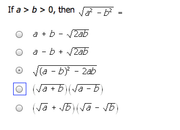
Jos wrote:Image

Can someone provide me with the rule for this one?
There's a nice rule that says √(xy) = (√x)(√y)
For example √(16*49) = (√16)(√49) = (4)(7) = 28

Since a² - b² = (a + b)(a - b), can use the above rule to conclude that...
its √[a² - b²] = √[(a+b)(a-b)] = [√(a+b)][√(a-b)] = D

Cheers,
Brent
Brent Hanneson - Creator of GMATPrepNow.com
Image
Join the discussion

by Scott@TargetTestPrep » Thu Nov 07, 2019 6:39 pm
Jos wrote:Image

Can someone provide me with the rule for this one?
Simplifying the given expression, we have:

√[(a + b)(a - b)] = √(a + b) x √(a - b)

Answer: D

Scott Woodbury-Stewart
Founder and CEO
[email protected]

Image

See why Target Test Prep is rated 5 out of 5 stars on BEAT the GMAT. Read our reviews

ImageImage
Join the discussion

by [email protected] » Sun Nov 24, 2019 11:34 am
Hi All,

This question has a great Geometry 'shortcut' built into it - but you have to recognize that the calculation is a variation on the Pythagorean Theorem (re: A^2 + B^2 = C^2). If you notice that, then you can TEST VALUES (using the classic 3/4/5 right triangle for the values). Here, that would be....

A = 5
B = 4
and the result of the calculation is 3. You'll find that only one answer matches...

Final Answer: [spoiler=]D[/spoiler]

GMAT assassins aren't born, they're made,
Rich
Contact Rich at [email protected]
Image
Join the discussion