BREAKING: Target Test Prep releases Brand New 2026 On Demand GMAT prep course

Redeem

Overlapping sets questions

Expert replies
by rjain84 » Thu Feb 21, 2013 6:56 am
In 1997, N people graduated from college. If 1/3 of them received a degree in the applied sciences, and, of those, 1/4 graduated from a school in one of six northeastern states, which of the following expressions represents the number of people who graduated from college in 1997 who did not both receive a degree in the applied sciences and graduate from a school in one of six northeastern states?

(A) 11N/12
(B) 7N/12
(C) 5N/12
(D) 6N/7
(E) N/7

Can anybody please point out what am I missing in my approach? I am using matrix method to solve it.

Let, Graduate students who got Applied Science degree = AS
Graduate students who did not get Applied Science degree = Not AS
Graduate students who were from north-eastern states = NES
Graduate students who were not from north-eastern states = NOT NES

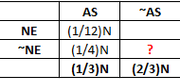
Matrix (please click on image to see the full matrix)
------
Image

We want to calculate x but according to the matrix it can't be determined. Please guide what am I missing here?
Join the discussion
Source: — Problem Solving |

by Brent@GMATPrepNow » Thu Feb 21, 2013 8:04 am
rjain84 wrote:In 1997, N people graduated from college. If 1/3 of them received a degree in the applied sciences, and, of those, 1/4 graduated from a school in one of six northeastern states, which of the following expressions represents the number of people who graduated from college in 1997 who did not both receive a degree in the applied sciences and graduate from a school in one of six northeastern states?

(A) 11N/12
(B) 7N/12
(C) 5N/12
(D) 6N/7
(E) N/7
Here's the Double Matrix method step-by-step:

Note: This technique can be used for most questions featuring a population in which each member has two criteria associated with it.
Here, the criteria are:
- degree(applied sciences or not)
- school location(north eastern state or not)

In 1997, N people graduated from college.
Image

1/3 of them received a degree in the applied sciences
Image

Of those (1/3)N students, 1/4 graduated from a school in one of six northeastern states.
Image
In other words, (1/12)N students have a degree in applied sciences and graduated from a northeastern school.

Which of the following expressions represents the number of people who graduated from college in 1997 who did not both receive a degree in the applied sciences and graduate from a school in one of six northeastern states?
If the box that has (1/12)N students in it represents the students with a degree in applied sciences and graduated from a northeastern school, then the remaining boxes (shaded in blue) must represent the students who did not both receive a degree in the applied sciences and graduate from a school in one of six northeastern states.
Image

Since all 4 boxes must add to N (the total number of students), the 3 shaded boxes must add to [spoiler](11/12)N[/spoiler].

Answer = A

Cheers,
Brent

Aside: For more information about the Double Matrix method and some additional practice questions, check out these 3 BTG articles:
- https://www.beatthegmat.com/mba/2011/05/ ... question-1
- https://www.beatthegmat.com/mba/2011/05/ ... question-2
- https://www.beatthegmat.com/mba/2011/05/ ... question-3
Brent Hanneson - Creator of GMATPrepNow.com
Image
Join the discussion

by GMATGuruNY » Thu Feb 21, 2013 8:06 am
rjain84 wrote:In 1997, N people graduated from college. If 1/3 of them received a degree in the applied sciences, and, of those, 1/4 graduated from a school in one of six northeastern states, which of the following expressions represents the number of people who graduated from college in 1997 who did not both receive a degree in the applied sciences and graduate from a school in one of six northeastern states?

(A) 11N/12
(B) 7N/12
(C) 5N/12
(D) 6N/7
(E) N/7

Can anybody please point out what am I missing in my approach? I am using matrix method to solve it.

Let, Graduate students who got Applied Science degree = AS
Graduate students who did not get Applied Science degree = Not AS
Graduate students who were from north-eastern states = NES
Graduate students who were not from north-eastern states = NOT NES

Matrix (please click on image to see the full matrix)
------
Image

We want to calculate x but according to the matrix it can't be determined. Please guide what am I missing here?
You don't need to complete the grid to answer the question.
According to the top left corner of your grid, (1/12)N of the students are both AS and NES.
Thus, the fraction that are NOT both AS and NES = N - (1/12)N = (11/12)N.

The correct answer is A.
Last edited by GMATGuruNY on Thu Feb 21, 2013 8:20 am, edited 1 time in total.
Private tutor exclusively for the GMAT and GRE, with over 20 years of experience.
Followed here and elsewhere by over 1900 test-takers.
I have worked with students based in the US, Australia, Taiwan, China, Tajikistan, Kuwait, Saudi Arabia -- a long list of countries.
My students have been admitted to HBS, CBS, Tuck, Yale, Stern, Fuqua -- a long list of top programs.

As a tutor, I don't simply teach you how I would approach problems.
I unlock the best way for YOU to solve problems.

For more information, please email me (Mitch Hunt) at [email protected].
Student Review #1
Student Review #2
Student Review #3
Join the discussion

by Brent@GMATPrepNow » Thu Feb 21, 2013 8:07 am
You can find 2 more Double Matrix practice questions (with free video solutions) here:
- https://www.gmatprepnow.com/module/gmat- ... ems?id=920
- https://www.gmatprepnow.com/module/gmat- ... ems?id=943

Cheers,
Brent
Brent Hanneson - Creator of GMATPrepNow.com
Image
Join the discussion

by rjain84 » Thu Feb 21, 2013 8:15 am
Brent@GMATPrepNow wrote:
rjain84 wrote:In 1997, N people graduated from college. If 1/3 of them received a degree in the applied sciences, and, of those, 1/4 graduated from a school in one of six northeastern states, which of the following expressions represents the number of people who graduated from college in 1997 who did not both receive a degree in the applied sciences and graduate from a school in one of six northeastern states?

(A) 11N/12
(B) 7N/12
(C) 5N/12
(D) 6N/7
(E) N/7
Here's the Double Matrix method step-by-step:

Note: This technique can be used for most questions featuring a population in which each member has two criteria associated with it.
Here, the criteria are:
- degree(applied sciences or not)
- school location(north eastern state or not)

In 1997, N people graduated from college.
Image

1/3 of them received a degree in the applied sciences
Image

Of those (1/3)N students, 1/4 graduated from a school in one of six northeastern states.
Image
In other words, (1/12)N students have a degree in applied sciences and graduated from a northeastern school.

Which of the following expressions represents the number of people who graduated from college in 1997 who did not both receive a degree in the applied sciences and graduate from a school in one of six northeastern states?
If the box that has (1/12)N students in it represents the students with a degree in applied sciences and graduated from a northeastern school, then the remaining boxes (shaded in blue) must represent the students who did not both receive a degree in the applied sciences and graduate from a school in one of six northeastern states.
Image

Since all 4 boxes must add to N (the total number of students), the 3 shaded boxes must add to [spoiler](11/12)N[/spoiler].

Answer = A

Cheers,
Brent

Aside: For more information about the Double Matrix method and some additional practice questions, check out these 3 BTG articles:
- https://www.beatthegmat.com/mba/2011/05/ ... question-1
- https://www.beatthegmat.com/mba/2011/05/ ... question-2
- https://www.beatthegmat.com/mba/2011/05/ ... question-3
Thanks a ton for the detailed explanation and for providing the links for more practice Brent!

However, I still have a doubt -

The phrase - "who did not both receive a degree in the applied sciences AND graduate from a school in one of six northeastern states?"

I think it means intersection not union (because of AND not OR)

So don't we want the value in the box (2,2) i.e the box in the lower right in the matix and not the values in all the shaded boxes?
Join the discussion

by Brent@GMATPrepNow » Thu Feb 21, 2013 8:26 am
rjain84 wrote:
Thanks a ton for the detailed explanation and for providing the links for more practice Brent!

However, I still have a doubt -

The phrase - "who did not both receive a degree in the applied sciences AND graduate from a school in one of six northeastern states?"

I think it means intersection not union (because of AND not OR)

So don't we want the value in the box (2,2) i.e the box in the lower right in the matix and not the values in all the shaded boxes?
Let's take a closer look at the phrase: "who did not both receive a degree in the applied sciences AND graduate from a school in one of six northeastern states"

If we ignore the not, we get: "who did both receive a degree in the applied sciences AND graduate from a school in one of six northeastern states"
These students are represented by the top-left box with (1/12)N students.

Once we put the not back into the phrase, we are referring to everybody else.

Cheers,
Brent
Brent Hanneson - Creator of GMATPrepNow.com
Image
Join the discussion

by rjain84 » Thu Feb 21, 2013 8:30 am
Brent@GMATPrepNow wrote:
Let's take a closer look at the phrase: "who did not both receive a degree in the applied sciences AND graduate from a school in one of six northeastern states"

If we ignore the not, we get: "who did both receive a degree in the applied sciences AND graduate from a school in one of six northeastern states"
These students are represented by the top-left box with (1/12)N students.

Once we put the not back into the phrase, we are referring to everybody else.

Cheers,
Brent
Gotcha! Your explanation makes perfect sense Brent. Many thanks once again.
Join the discussion

by pareekbharat86 » Sun Nov 03, 2013 9:03 pm
Brent@GMATPrepNow wrote:
rjain84 wrote:In 1997, N people graduated from college. If 1/3 of them received a degree in the applied sciences, and, of those, 1/4 graduated from a school in one of six northeastern states, which of the following expressions represents the number of people who graduated from college in 1997 who did not both receive a degree in the applied sciences and graduate from a school in one of six northeastern states?

(A) 11N/12
(B) 7N/12
(C) 5N/12
(D) 6N/7
(E) N/7
Here's the Double Matrix method step-by-step:

Note: This technique can be used for most questions featuring a population in which each member has two criteria associated with it.
Here, the criteria are:
- degree(applied sciences or not)
- school location(north eastern state or not)

In 1997, N people graduated from college.
Image

1/3 of them received a degree in the applied sciences
Image

Of those (1/3)N students, 1/4 graduated from a school in one of six northeastern states.
Image
In other words, (1/12)N students have a degree in applied sciences and graduated from a northeastern school.

Which of the following expressions represents the number of people who graduated from college in 1997 who did not both receive a degree in the applied sciences and graduate from a school in one of six northeastern states?
If the box that has (1/12)N students in it represents the students with a degree in applied sciences and graduated from a northeastern school, then the remaining boxes (shaded in blue) must represent the students who did not both receive a degree in the applied sciences and graduate from a school in one of six northeastern states.
Image

Since all 4 boxes must add to N (the total number of students), the 3 shaded boxes must add to [spoiler](11/12)N[/spoiler].

Answer = A

Cheers,
Brent

Aside: For more information about the Double Matrix method and some additional practice questions, check out these 3 BTG articles:
- https://www.beatthegmat.com/mba/2011/05/ ... question-1
- https://www.beatthegmat.com/mba/2011/05/ ... question-2
- https://www.beatthegmat.com/mba/2011/05/ ... question-3
The ques asks to find the prob. selecting students who did not both receive a degree in the applied sciences and graduate from a school in one of six northeastern states.

Therefore, we should be looking at the following:


Image


Why am I not correct?[/u]
Thanks,
Bharat.
Join the discussion

by Brent@GMATPrepNow » Sun Nov 03, 2013 10:10 pm
pareekbharat86 wrote:
The ques asks to find the prob. selecting students who did not both receive a degree in the applied sciences and graduate from a school in one of six northeastern states.

Therefore, we should be looking at the following:

Image

Why am I not correct?[/u]
The bottom right box that you are referring to represents the number of students who NEITHER received a degree in the applied sciences NOR graduated from a school in one of six northeastern states.

This is not what the question is asking for. We want the number of students who who did not both receive a degree in the applied sciences and graduate from a school in one of six northeastern states.

So, if the top-left box represents students who both received a degree in the applied sciences AND graduated from a school in one of six northeastern states, then the remaining 3 boxes represent the number of students who who did not both receive a degree in the applied sciences and graduate from a school in one of six northeastern states.

I hope that helps.

Cheers,
Brent
Brent Hanneson - Creator of GMATPrepNow.com
Image
Join the discussion

by pareekbharat86 » Sun Nov 03, 2013 11:48 pm
Brent@GMATPrepNow wrote:
pareekbharat86 wrote:
The ques asks to find the prob. selecting students who did not both receive a degree in the applied sciences and graduate from a school in one of six northeastern states.

Therefore, we should be looking at the following:

Image

Why am I not correct?[/u]
The bottom right box that you are referring to represents the number of students who NEITHER received a degree in the applied sciences NOR graduated from a school in one of six northeastern states.

This is not what the question is asking for. We want the number of students who who did not both receive a degree in the applied sciences and graduate from a school in one of six northeastern states.

So, if the top-left box represents students who both received a degree in the applied sciences AND graduated from a school in one of six northeastern states, then the remaining 3 boxes represent the number of students who who did not both receive a degree in the applied sciences and graduate from a school in one of six northeastern states.

I hope that helps.

Cheers,
Brent
The language of the question stumped me!

Thanks a lot Brent. I am discovering how helpful this website is! Wish you guys all the best.
Thanks,
Bharat.
Join the discussion

by bzb » Wed Nov 06, 2013 3:01 pm
hi,

I am still in doubt about this question...I tried this other question:

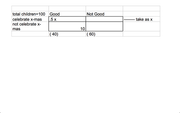
Santa estimates that 10% of the children in the world have been good this year but do not celebrate Christmas, and that 50% of the children who celebrate Christmas have been good this year. If 40% of the children in the world have been good, what percentage of children in the world are not good and do not celebrate Christmas?

the grid I made was like this:


Image


...how is not good and not celebrating christmas different from both not good and not celebrating christmas? I thought that like the given problem about graduates, I should take the entire region (60+10) as neither good nor celebrate x-mss

could someone please point out the difference between them.....

-thanks
Join the discussion