BREAKING: Target Test Prep releases Brand New 2026 On Demand GMAT prep course

Redeem

Target Test Prep · GMAT

Choose how you want to prepare

Learn live with an expert or move at your own pace. Every option includes the complete TTP study system.

★★★★★5.0559 reviews
GMATLiveTeach 7 seats left
Chris Peckover
NEXT LIVE COHORT

Oct 13 to Jan 7, 2027

with Chris Peckover

Schedule
Tue, Thu · 8:00 to 10:00 PM ET
Included
40 live hours + 6 months of GMAT OnDemand
  • Live instruction and real-time questions
  • Class recordings and assigned practice
View class & enroll
Limited cohort · enrollment openTarget Test Prep
EALiveTeach 5 seats left
Logan Thompson
EXECUTIVE ASSESSMENT

Sep 6 to Dec 6, 2026

with Logan Thompson

Schedule
Sun · 9:30 AM to 12:30 PM ET
Included
40 hours of live online classes plus six months of access to the complete TTP EA OnDemand course.
  • 165+ EA Score Guarantee
  • 4,100+ Quant, Verbal, and Integrated Reasoning practice questions
  • 400+ hours of in-depth video lessons
  • 3,000+ step-by-step video solutions
View EA class & enroll
Limited cohort · enrollment openTarget Test Prep
GMATOnDemand Start anytime
SELF-PACED MASTERCLASS

Target Test Prep GMAT OnDemand

Complete access from day one. Study on your schedule.

715+ score guarantee
$0to start then $127/mo
  • Personalized study plan and analytics
  • Thousands of lessons and practice questions

Compare the format, schedule, and included access before enrolling. Prices and seat counts shown reflect the supplied offer details.

Inequality doubt

Expert replies
by sachin_yadav » Mon Apr 08, 2013 8:53 am
Hi,

Can anyone please help me in solving the following inequalities:-

(1). x/(x + 2) <= 1/x
My approach :- x/(x + 2) - 1/x <= 0

After calculating, (x - 2)(x + 1) / x(x + 2) <= 0

What is after this ? how can i get the inequality ? What is the right approach ?

(2). x/(x - 3) <= 1/x

Please help in the above questions.

Thanks
Sachin
Never surrender
Join the discussion
Source: — Problem Solving |

by Anju@Gurome » Mon Apr 08, 2013 9:03 am
Please go through the post I made here >> https://www.beatthegmat.com/gmat-prep-ea ... tml#602154
sachin_yadav wrote:x/(x + 2) <= 1/x
My approach :- x/(x + 2) - 1/x <= 0

After calculating, (x - 2)(x + 1) / x(x + 2) <= 0
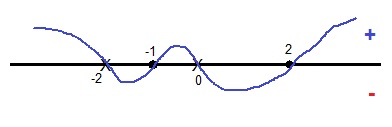
(x - 2)(x + 1)/[x(x + 2)] ≤ 0

Critical points of this inequality are : -2, -1, 0, and 2.
Image

As we are looking for less than or equal to zero region, our solution set is -2 < x ≤ -1 and 0 < x ≤ 2
Anju Agarwal
Quant Expert, Gurome

Backup Methods : General guide on plugging, estimation etc.
Wavy Curve Method : Solving complex inequalities in a matter of seconds.

§ GMAT with Gurome § Admissions with Gurome § Career Advising with Gurome §
Join the discussion

by Anju@Gurome » Mon Apr 08, 2013 9:22 am
sachin_yadav wrote:(2). x/(x - 3) ≤ 1/x
--> x/(x - 3) - 1/x ≤ 0
--> [x² - x + 3]/[x(x - 3)] ≤ 0

Now, x² - x + 3 is always positive as
  • for |x| > 1, x² > x --> (x² - x) > 0 ---> (x² - x + 3) > 0
    for |x| < 1, -1 < (x² - x) < 0 ---> (x² - x + 3) > 0
    For x = 0, (x² - x + 3) = 3 > 0
So our effective inequality is 1/[x(x - 3)] ≤ 0 ---> x(x - 3) < 0 (I replaced ≤ with ≤ because 1/[x(x - 3)] can never be equal to zero)
--> Either {x < 0 and (x - 3) > 0} or {x > 0 and (x - 3) < 0}
--> Either {x < 0 and x > 3} or {x > 0 and x < 3}

The first one is not possible for any x.
Hence, our final solution is 0 < x < 3
Last edited by Anju@Gurome on Wed Apr 17, 2013 7:57 am, edited 1 time in total.
Anju Agarwal
Quant Expert, Gurome

Backup Methods : General guide on plugging, estimation etc.
Wavy Curve Method : Solving complex inequalities in a matter of seconds.

§ GMAT with Gurome § Admissions with Gurome § Career Advising with Gurome §
Join the discussion

by GMATGuruNY » Mon Apr 08, 2013 11:44 am
sachin_yadav wrote:Hi,

Can anyone please help me in solving the following inequalities:-

(1). x/(x + 2) <= 1/x
My approach :- x/(x + 2) - 1/x <= 0

After calculating, (x - 2)(x + 1) / x(x + 2) <= 0

What is after this ?
Check my post here:

https://www.beatthegmat.com/og-13-229-ho ... 11325.html
Private tutor exclusively for the GMAT and GRE, with over 20 years of experience.
Followed here and elsewhere by over 1900 test-takers.
I have worked with students based in the US, Australia, Taiwan, China, Tajikistan, Kuwait, Saudi Arabia -- a long list of countries.
My students have been admitted to HBS, CBS, Tuck, Yale, Stern, Fuqua -- a long list of top programs.

As a tutor, I don't simply teach you how I would approach problems.
I unlock the best way for YOU to solve problems.

For more information, please email me (Mitch Hunt) at [email protected].
Student Review #1
Student Review #2
Student Review #3
Join the discussion

by misterholmes » Wed Apr 10, 2013 7:41 am
sachin_yadav wrote:Hi,

Can anyone please help me in solving the following inequalities:-

(1). x/(x + 2) <= 1/x
My approach :- x/(x + 2) - 1/x <= 0

After calculating, (x - 2)(x + 1) / x(x + 2) <= 0

What is after this ? how can i get the inequality ? What is the right approach ?

(2). x/(x - 3) <= 1/x

Please help in the above questions.

Thanks
Sachin
Hey Sachin, without anything to go on for x, you have to look out for two kinds of trouble, when dividing by 0 and when multiplying (or dividing) by a negative number. When you put your equation (I) terms over a common denominator, the inequality could change directions on you, depending on the x values you're considering.

Kind Regards,

Misterholmes
www.gmatdojo.com
Mindfulness, Concentration, Insight
Join the discussion

by jainpiyushjain » Wed May 22, 2013 10:03 am
Anju@Gurome wrote: Now, x² - x + 3 is always positive as
  • for |x| > 1, x² > x --> (x² - x) > 0 ---> (x² - x + 3) > 0
    for |x| < 1, -1 < (x² - x) < 0 ---> (x² - x + 3) > 0
    For x = 0, (x² - x + 3) = 3 > 0
So our effective inequality is 1/[x(x - 3)] ≤ 0 ---> x(x - 3) < 0 (I replaced ≤ with ≤ because 1/[x(x - 3)] can never be equal to zero)
--> Either {x < 0 and (x - 3) > 0} or {x > 0 and (x - 3) < 0}
--> Either {x < 0 and x > 3} or {x > 0 and x < 3}

The first one is not possible for any x.
Hence, our final solution is 0 < x < 3
Dear Anju

Can you please explain this question again. I was not able to understand how did you prove x² - x + 3 is always positive and why did you consider |x| > 1 and |x| < 1.

Thank you
Join the discussion

by fifafreak » Thu May 23, 2013 12:19 am
jainpiyushjain wrote:
Anju@Gurome wrote: Now, x² - x + 3 is always positive as
  • for |x| > 1, x² > x --> (x² - x) > 0 ---> (x² - x + 3) > 0
    for |x| < 1, -1 < (x² - x) < 0 ---> (x² - x + 3) > 0
    For x = 0, (x² - x + 3) = 3 > 0
So our effective inequality is 1/[x(x - 3)] ≤ 0 ---> x(x - 3) < 0 (I replaced ≤ with ≤ because 1/[x(x - 3)] can never be equal to zero)
--> Either {x < 0 and (x - 3) > 0} or {x > 0 and (x - 3) < 0}
--> Either {x < 0 and x > 3} or {x > 0 and x < 3}

The first one is not possible for any x.
Hence, our final solution is 0 < x < 3[/quot

Dear Anju

Can you please explain this question again. I was not able to understand how did you prove x² - x + 3 is always positive and why did you consider |x| > 1 and |x| < 1.

Thank you
Simply put, if we consider x^2 - x + 3 => x = negative => x^2 positive, -x will be positive, +3 (positive) --> Hence, expression positive.

x= positive => x^2 = positive, -x negative but less than x^2 [hence x^2 - x is positive] +3 which makes the expression positive, irrespective of whatever value x holds.
Join the discussion

by fifafreak » Thu May 23, 2013 12:28 am
sachin_yadav wrote:Hi,

Can anyone please help me in solving the following inequalities:-

(1). x/(x + 2) <= 1/x
My approach :- x/(x + 2) - 1/x <= 0

After calculating, (x - 2)(x + 1) / x(x + 2) <= 0

What is after this ? how can i get the inequality ? What is the right approach ?

(2). x/(x - 3) <= 1/x

Please help in the above questions.

Thanks
Sachin
Both the problems will have a similar approach. You have to take care of 2 things :
[1] Denominator cannot be zero.
[2] When Numerator is positive, denominator will be negative and vice versa [since the expression is negative]

problem 1.
(x-2)(x-3)/x(x+2) <=0
Numerator positive or zero: x E [-inf, -1]U[2, inf]; Denominator negative: x E (-2,0) => x E (-2,-1]
Numerator negative or zero: x E [-1,2]; Denominator positive: x E (-inf., -2)U(0, inf)=> x E (0,2]

problem 2.

Numerator always positive, hence Denominator should be negative for the inequality to hold true.

x(x-3) < 0 ---> x E (0,3)
Join the discussion