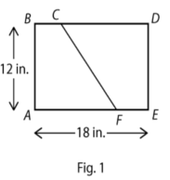
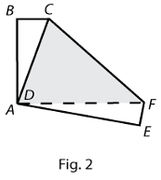
The diagrams are confusing, because they aren't to scale -- in the second diagram, AF is suddenly much longer than in the first, even though the length AF hasn't changed.
Regardless, after folding the paper, the angle at E remains a 90 degree angle, the length of DE is still 12, and the lengths AF and FE must add to 18. So the triangle at the bottom, AEF, is a right triangle. If we call its shortest side, EF, "c", then its hypotenuse is 18-c, because AF and FE add to 18. So by Pythagoras,
c^2 + 12^2 = (18 - c)^2
Seeing that the answers all work out to integers, you might, seeing the "12", guess that this is a 5-12-13 triangle. That turns out to be the case. Or you could solve the equation:
c^2 + 12^2 = 18^2 - 36c + c^2
36c = 18^2 - 12^2
36c = (18 + 12)(18 - 12)
36c = 30*6
c = 5
Since c is the length of AF, and since the lengths of AF and EF sum to 18, the length of EF is 13. So in the shaded triangle, if we take the horizontal line AF as the base, the base is 13, and the height is 12, so the area is (13*12)/2 = 78.
For online GMAT math tutoring, or to buy my higher-level Quant books and problem sets, contact me at ianstewartgmat at gmail.com
ianstewartgmat.com