


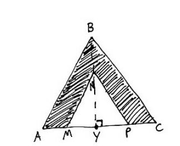
Zoom here, https://postimg.cc/image/q41qng77v/
In the figure above, triangle ABC and MNP are both isosceles. AB is parallel to MN, BC is parallel to NP, the lenght of AC is 7 and the lenght of BY is 4. If the area of the unshaded region is equal to the area of the shaded region, what is the lenght of MP?
$$A.\ 2\sqrt{2}$$
$$B.\ 2\sqrt{7}$$
$$C.\ \frac{2\sqrt{3}}{3}$$
$$D.\ \frac{7\sqrt{2}}{2}$$
$$E.\ \frac{7\sqrt{3}}{3}$$
The OA is D.
If the area of unshaded region is equal to the area of shaded region, then the area of the big triangle is twice the area of the little triangle, right?
Then, I can say that
$$Area_{\triangle ABC}=2\cdot Area_{\triangle MNP}$$
I stuck here. I think that it should be solve it using similar triangles theory, but I don't understand how can I apply it. Experts, any suggestion, please? Thanks.




















