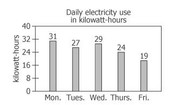
For the 5 days shown in the graph, how many kilowatt-hours

This topic has expert replies
Source: — Problem Solving |

GMAT/MBA Expert

User avatar
GMAT Instructor
Posts: 2095
Joined: Tue Dec 04, 2012 3:22 pm
Thanked: 1443 times
Followed by:247 members

by ceilidh.erickson » Tue Mar 05, 2019 11:25 am
To find the median, first list the daily kilowatt-hours in order:
19, 24, 27, 29, 31

The median = 27

To find the average, we could add up all the terms and divide by 5. Instead, though, just see how much each term differs from the median:
19 --> 27 - 8
24 --> 27 - 3
27
29 --> 27 + 2
31 --> 27 +4

-8 + -3 + 2 + 4 = -5 overall

In other words, the overall sum is 5 less than the sum of the hypothetical set 27, 27, 27, 27, 27.
Therefore, the average must be 1 less than the sum of the hypothetical set 27, 27, 27, 27, 27.
--> -5 divided across 5 terms.

Thus, the median is 1 greater than the mean.

The answer is A.
Ceilidh Erickson
EdM in Mind, Brain, and Education
Harvard Graduate School of Education


GMAT/MBA Expert

User avatar
GMAT Instructor
Posts: 8083
Joined: Sat Apr 25, 2015 10:56 am
Location: Los Angeles, CA
Thanked: 43 times
Followed by:29 members

by Scott@TargetTestPrep » Fri Mar 08, 2019 6:51 am
swerve wrote:Image

For the 5 days shown in the graph, how many kilowatt-hours greater was the median daily electricity use than the average (arithmetic mean) daily electricity use?

A. 1
B. 2
C. 3
D. 4
E. 5

The OA is A

Source: GMAT Prep
Listing the numbers from smallest to largest, we have: 19, 24, 27, 29 and 31. So 27 is the median. The average is (19 + 24 + 27 + 29 + 31)/5 = 130/5 = 26. Therefore, the median exceeds the average by 1.

Answer: A

Scott Woodbury-Stewart
Founder and CEO
[email protected]

Image

See why Target Test Prep is rated 5 out of 5 stars on BEAT the GMAT. Read our reviews

ImageImage