chaithu_bunny wrote:In the fig shown, what is the value of x?
1 Length of Line segment QR is equal to Length of Line segment RS.
2 Length of Line segment ST is equal to Length of Line segment TU.
Note that the measure of angle x depends upon the position of points Q, S and U only. Unless we don't know the fixed positions of these three points, we cannot uniquely determine the measure of angle x.
Statement 1: QR = RS
Thus position of Q and S is fixed. But U can be any point on PT and accordingly value of x will be different.
Not sufficient.
Statement 2: ST = TU
Thus position of S and U is fixed. But Q can be any point on PR and accordingly value of x will be different.
Not sufficient.
1 & 2 Together: Now the three points are fixed. Let's see whether we can find x. Refer to the image below.
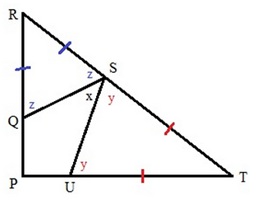
On point S, the sum of the three angles must be equal to 180°.
Thus, (x + y + z) = 180° ..................................... (i)
angle PQS = (180° - angle RQS) = (180° - z)
angle PUS = (180° - angle TUS) = (180° - y)
Now in quadrilateral PQSU,
Sum of all the internal angles = 360°
--> [x + 90° + (180° - y) + (180° - z)] = 360°
--> (x - y - z + 90°) = 0 .................................. (ii)
Now add (i) and (ii) ---> (2x + 90°) = 180° ---> x = 45°
Sufficient
The correct answer is C.























