VJesus12 wrote: ↑Fri Feb 19, 2021 6:19 am
A marketing firm determined that, of \(200\) households surveyed, \(80\) used neither Brand \(A\) nor Brand \(B\) soap, \(60\) used only Brand \(A\) soap, and for every household that used both brands of soap, \(3\) used only Brand \(B\) soap. How many of the \(200\) households surveyed used both brands of soap?
(A) 15
(B) 20
(C) 30
(D) 40
(E) 45
Answer:
A
Source: Official Guide
Here's a step-by-step approach using the
Double Matrix method.
Here, we have a population of 200 households , and the two characteristics are:
- using or not using Brand A soap
- using or not using Brand B soap
So, we can set up our matrix as follows (where "~" represents "not"):
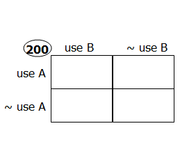 80 used neither Brand A nor Brand B soap
We can add this to our diagram as follows:
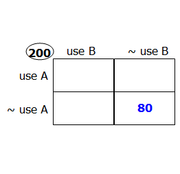 60 used only Brand A soap
We get...
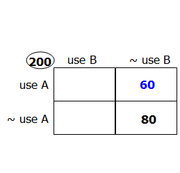
At this point, we can see that the right-hand column adds to 140, which means 140 households do NOT use brand B soap.
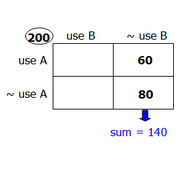
Since there are 200 households altogether, we can conclude that 60 households DO use brand B soap.
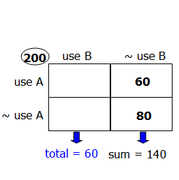 For every household that used BOTH brands of soap...
Let's let x = # of households that use BOTH brands....
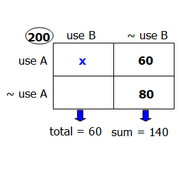 ...3 used only Brand B soap.
So, 3x = # of households that use ONLY brand B soap
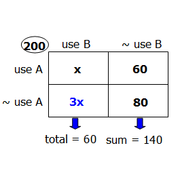
At this point, when we examine the left-hand column, we can see that
x + 3x = 60
Simplify to get 4x = 60
Solve to get
x = 15
How many of the 200 households surveyed used BOTH brands of soap?
Since x = # of households that use BOTH brands of soap, the correct answer here is: A
Brent Hanneson - Creator of GMATPrepNow.com



























