
In the figure above, ABCD is a square, and the two diagonal lines divide it into three regions of equal area. If AB = 3, what is the length of w, the perpendicular distance between the two diagonal lines?
A) 3√2 - 2√3
B) 3√2 - √6
C) √2
D)

E) 2√3 - √6
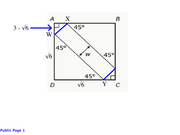
The area of square ABCD = 3² = 9.
Since the square is divided into 3 equal regions, the area of triangle DWY = 3.
Thus:
(1/2)(DY)(WD) = 3.
Since triangle DWY is isosceles, DY=WD.
Thus:
(1/2)(WD)(WD) = 3
WD² = 6
WD = √6.
Since AD = 3 and WD = √6, AW = 3 - √6.
Triangle AXW is a 45-45-90 triangle.
(Don't worry about a proof. It should be clear from the figure that AXW is an isosceles right triangle.)
Since the sides in triangle AXW are proportioned 1:1:√2, we get:
WX = (3 - √6)√2 = 3√2 - √12 = 3√2 - 2√3.
The correct answer is
A.
Private tutor exclusively for the GMAT and GRE, with over 20 years of experience.
Followed here and elsewhere by over 1900 test-takers.
I have worked with students based in the US, Australia, Taiwan, China, Tajikistan, Kuwait, Saudi Arabia -- a long list of countries.
My students have been admitted to HBS, CBS, Tuck, Yale, Stern, Fuqua -- a long list of top programs.
As a tutor, I don't simply teach you how I would approach problems.
I unlock the best way for YOU to solve problems.
For more information, please email me (Mitch Hunt) at
[email protected].
Student Review #1
Student Review #2
Student Review #3























