BREAKING: Target Test Prep releases Brand New 2026 On Demand GMAT prep course

Redeem

What is the perimeter of a certain right triangle?

Expert replies
by AAPL » Fri Jul 27, 2018 6:50 am

Timer

00:00

Answers

A

B

C

D

E

Stats

Difficulty

What is the perimeter of a certain right triangle?

(1) The hypotenuse's length is 10
(2) The triangle's area is 24

The OA C.

The trick with this question is that in statement 1 we cannot actually assume that the sides are 6 and 8 just because we know that
x^2 +y^2 = 100

We cannot make any assumptions about X and Y UNLESS there is a restriction such as "X and Y must be integers" or "The product of XY is 48."

Hence, the correct answer is C.

Has anyone another strategic approach to solving this DS question? Regards!
Join the discussion
Source: — Data Sufficiency |

by deloitte247 » Fri Sep 07, 2018 12:38 pm
Perimeter of a triangle = Side a + Side b + Side c
However, if we have 2 known sides we can find the third side with Pythagoras theories before calculating the perimeter.

Statement 1 = The hypotenuse length is 10
Given that hypotenuse = 10
Let opposite and adjacent be a and b respectively.
From Pythagoras theories; we have
$$10^2\ =\ a^2\ +\ b^2$$
$$100\ =\ a^2\ +\ b^2$$
The given information is not enough to find the perimeter of the triangle, hence statement 1 is INSUFFICIENT.

Statement 2 = The triangle's are is 24
$$Area\ of\ triangle\ =\ \frac{1}{2}\ \cdot\ base\ \cdot\ height.$$
$$=\ \frac{1}{2}\ \cdot\ opposite\ \cdot\ adjacent.$$
$$=\ \frac{1}{2}\ \cdot\ a\ \cdot\ b.$$
$$24=\ \frac{1}{2}\ \cdot\ a\ \cdot\ b.$$
$$24=\ \frac{ab}{2}$$
$$ab\ =\ 48$$
This does not provide us with information on any of the sides, hence Statement 2 is INSUFFICIENT.

Combining Statement 1 and 2 together =
$$a^2\ +\ b^2\ =100\ -\ Statement\ 1$$
$$ab=48\ -\ Statement\ 2$$
From Statement 1
$$a^2\ +\ b^2\ =\ 100$$
$$a^2\ +\ b^2\ can\ bw\ written\ as\ \left(a\ +\ b\right)^2$$
$$\left(a\ +\ b\right)^2\ =\ \left(a\ +\ b\right)\cdot\left(a\ +\ b\right)$$
$$=\left(a\ \cdot\ a\right)\ +\left(a\ \cdot b\right)+\left(b\ \cdot\ a\right)+\ \left(b\cdot b\right)$$
$$=a^2\ +\ b^2\ +\ 2ab$$
$$From\ Statement\ 1\ a^2\ +\ b^2\ =100$$
$$From\ Statement\ 2\ \ ab=\ 48$$
$$\left(a\ +\ b\right)^2\ =\ \left(a^{2\ }+b^2\right)+\ \left(2ab\right)$$
$$=\ \left(100\right)\ +\ \left(2\ \cdot\ 48\right)$$
$$=\ 100\ +\ 96$$ $$=196$$
$$\sqrt{\left(a\ +\ b\right)^2}=\sqrt{196}$$
$$a\ +\ b\ =\ 14$$
We already have hypotenuse as 10
Opposite and adjacent as a + b = 14
Perimeter = (a + b ) + 10
=14 + 10
= 24
Option C is CORRECT.
Join the discussion

by fskilnik@GMATH » Fri Sep 14, 2018 2:25 pm
AAPL wrote:What is the perimeter of a certain right triangle?

(1) The hypotenuse's length is 10
(2) The triangle's area is 24

Has anyone another strategic approach to solving this DS question? Regards!
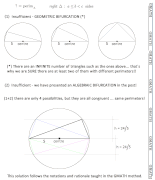
Sure! The key point is to understand we are looking for the uniqueness (or not) of numerical values, not explicit calculations!
(Our method has this important detail in its "backbone" when dealing with ANY Data Sufficiency problem... especially in Geometry-related ones!)

\[right\,\,\Delta \,\,\,:\,\,\,a \leqslant b < c\,\,\,{\text{sides}}\,\,\,\,\,\]
\[?\,\, = \,\,{\text{peri}}{{\text{m}}_{\,\Delta }}\]

\[\left( 1 \right)\,\,\,{\text{c}} = 10\,\,\,\,\,::\,\,\,\,{\text{GEOMETRIC}}\,\,{\text{BIFURCATION}}\,\,\,\,\,\,\left( {{\text{see}}\,\,{\text{image}}\,\,{\text{attached}}} \right)\,\,\]

\[\left( 2 \right)\,\,\,{S_\Delta } = 24\,\,\,\left\{ \begin{gathered}
\,\left( {a,b,c} \right) = \left( {3 \cdot 2\,\,,4 \cdot 2\,\,,\,\,5 \cdot 2} \right)\,\,\,\,\,\,\left[ {3k,4k,5k} \right]\,\,\,\,\,\,\,\,\, \Rightarrow \,\,\,\,\,\,\,\,?\,\,\, = \,\,\,2\left( {3 + 4 + 5} \right) = 24 \hfill \\
\,\left( {a,b,c} \right) = \left( {\sqrt {2 \cdot 24} \,\,,\sqrt {2 \cdot 24} \,\,,\,\,\sqrt {2 \cdot 24} \, \cdot \sqrt 2 } \right)\,\,\,\,\,\,\,\,\,\left[ {L,L,L\sqrt 2 } \right]\,\,\,\,\,\,\,\,\, \Rightarrow \,\,\,\,\,\,\,?\,\,\, \ne \,\,24 \hfill \\
\end{gathered} \right.\]

\[\left( {1 + 2} \right)\,\,24 = \frac{{10 \cdot h}}{2}\,\,\,\,\, \Rightarrow \,\,\,\,h\,\,\,{\text{unique}}\,\,\,\,\,\mathop \Rightarrow \limits^{\left( {{\text{see}}\,\,{\text{image}}\,\,{\text{attached}}} \right)} \,\,\,\,\Delta \,\,\,unique\,\,\,\left( {{\text{but}}\,\,{\text{congruents!}}} \right)\,\,\,\,\,\, \Rightarrow \,\,\,\,\,?\,\, = \,\,{\text{peri}}{{\text{m}}_{\,\Delta }}\,\,\,{\text{unique}}\]

This solution follows the notations and rationale taught in the GMATH method.

Regards,
Fabio.

Image
Fabio Skilnik :: GMATH method creator ( Math for the GMAT)
English-speakers :: https://www.gmath.net
Portuguese-speakers :: https://www.gmath.com.br
Join the discussion