BTGmoderatorDC wrote:If a circle is inscribed in an equilateral triangle, what is the area of the triangle NOT taken up by the circle?
(1) The area of the circle is 12Ï€
(2) The length of a side of the triangle is 12
\[? = {S_{\,{\text{grey}}}}\,\,\,\,\left( {{\text{figure}}} \right)\]
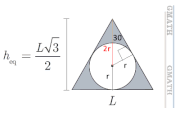
Using the 30-60-90 shortcut in the triangle shown in the figure, we were able to relate all elements involved, so that:
\[?\,\, = \,\,\frac{{L \cdot {h_{{\text{eq}}}}}}{2} - \pi {r^2}\, = \,\,\,\frac{{{L^2} \cdot \,\sqrt 3 }}{4} - \pi {r^2}\,\,\mathop = \limits^{\left( * \right)} \,3{r^2} \cdot \sqrt 3 - \pi {r^2} = \boxed{{r^2}\left( {3\sqrt 3 - \pi } \right)}\,\,\,\left( {**} \right)\]
\[\left( * \right)\,\,\frac{{L\sqrt 3 }}{2} = {h_{{\text{eq}}}}\mathop = \limits^{figure} \,\,3r\,\,\,\,\mathop \Rightarrow \limits^{ \cdot \,\,2\sqrt 3 \,\,} \,\,3L = 6r\sqrt 3 \,\,\, \Rightarrow \,\,\,\,L = 2r\sqrt 3 \]
\[\left( 1 \right)\,\,\pi {r^2} = 12\pi \,\,\,\, \Rightarrow \,\,\,{r^2} = 12\,\,\,\,\mathop \Rightarrow \limits^{\left( {**} \right)} \,\,\,\,? = \,\,{\text{unique}}\]
\[\left( 2 \right)\,\,L = 12\,\,\, \Rightarrow \,\,\,3r = {h_{{\text{eq}}}}\,\,{\text{unique}}\,\,\, \Rightarrow \,\,\,{r^2} = \,\,{\text{unique}}\,\,\,\,\,\,\mathop \Rightarrow \limits^{\left( {**} \right)} \,\,\,\,? = \,\,{\text{unique}}\]
This solution follows the notations and rationale taught in the GMATH method.