BREAKING: Target Test Prep releases Brand New 2026 On Demand GMAT prep course

Redeem

A manufacturer

Expert replies
by Java_85 » Sat Oct 05, 2013 4:32 pm
A manufacturer conducted a survey to determine how many people buy products P and Q. What fraction of the people surveyed said that they buy neither product P nor product Q?

(1) 1/3 of the people surveyed said that they buy product P but not product Q.
(2) 1/2 of the people surveyed said that they buy product Q.
Join the discussion
Source: — Data Sufficiency |

by vinay1983 » Sat Oct 05, 2013 4:39 pm
Java_85 wrote:A manufacturer conducted a survey to determine how many people buy products P and Q. What fraction of the people surveyed said that they buy neither product P nor product Q?

(1) 1/3 of the people surveyed said that they buy product P but not product Q.
(2) 1/2 of the people surveyed said that they buy product Q.
Is it C
You can, for example never foretell what any one man will do, but you can say with precision what an average number will be up to!
Join the discussion

by Java_85 » Sat Oct 05, 2013 4:43 pm
Yes, It is, I think to answer this question we need to know how many people are buying both products P and Q, but question didn't say anything about it.
vinay1983 wrote:
Java_85 wrote:A manufacturer conducted a survey to determine how many people buy products P and Q. What fraction of the people surveyed said that they buy neither product P nor product Q?

(1) 1/3 of the people surveyed said that they buy product P but not product Q.
(2) 1/2 of the people surveyed said that they buy product Q.
Is it C
Join the discussion

by vinay1983 » Sat Oct 05, 2013 4:59 pm
This can be solved using the double matrix method. You have to quickly realize that Individually the statements are not enough. So combine and solve
You can, for example never foretell what any one man will do, but you can say with precision what an average number will be up to!
Join the discussion

by rakeshd347 » Sat Oct 05, 2013 5:01 pm
Java_85 wrote:Yes, It is, I think to answer this question we need to know how many people are buying both products P and Q, but question didn't say anything about it.
vinay1983 wrote:
Java_85 wrote:A manufacturer conducted a survey to determine how many people buy products P and Q. What fraction of the people surveyed said that they buy neither product P nor product Q?

(1) 1/3 of the people surveyed said that they buy product P but not product Q.
(2) 1/2 of the people surveyed said that they buy product Q.
Is it C
Hi Mate
answer should be C

we are asked about the fraction so two statements together are sufficient. Have a look at my explanation through attachment. i have used double matrix method to solve it.
Attachments
Double matrix method..docx
(46.13 KiB) Downloaded 219 times
Join the discussion

by vinay1983 » Sat Oct 05, 2013 5:18 pm
took the LCM of 2 and 3, say 6
Attachments
Double Matrix.docx
(18.47 KiB) Downloaded 196 times
You can, for example never foretell what any one man will do, but you can say with precision what an average number will be up to!
Join the discussion

A manufacturer

by Brent@GMATPrepNow » Sat Oct 05, 2013 5:42 pm
Java_85 wrote:A manufacturer conducted a survey to determine how many people buy products P and Q. What fraction of the people surveyed said that they buy neither product P nor product Q?

(1) 1/3 of the people surveyed said that they buy product P but not product Q.
(2) 1/2 of the people surveyed said that they buy product Q.

This is a great candidate for a technique called the Double Matrix Method. It can be used for most questions featuring a population in which each member has two criteria associated with it.
Here, the criteria are:
- buy product Q or not buy product Q
- buy product P or not buy product P
When I scan the two statements I see that they mention 1/3 of the people surveyed and 1/2 of the people surveyed. I also see that the target question asks us to find a fraction of the people surveyed (not the actual number). So, let's pick a nice number that works well with 1/3 and 1/2.
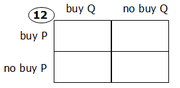
Let's say there 12 people were surveyed.

So, we'll start by setting up our diagram like this:
Image
Aside: To learn more about this technique, watch our free video: https://www.gmatprepnow.com/module/gmat- ... ems?id=919

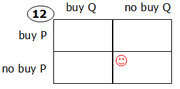
We want to find the fraction of the people surveyed said that they neither buy product P nor product Q. So, to answer this question, we need to know the number of people in the bottom right box (where the happy face is).
Image

We're now ready to check the statements.

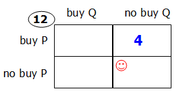
Statement 1: 1/3 of the people surveyed said that they buy product P but not product Q.
1/3 of 12 = 4. So, 4 people buy product P but not product Q.
Image
Does this provide enough information to find the number of people in the bottom right box (where the happy face is)?
No.
Statement 1 is NOT SUFFICIENT

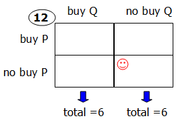
Statement 2: 1/2 of the people surveyed said that they buy product Q.
So, 6 people buy product Q, which means 6 people do not buy product Q
Image
Does this provide enough information to find the number of people in the bottom right box (where the happy face is)?
No.
Statement 2 is NOT SUFFICIENT


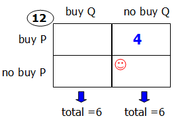
Statements 1 and 2 combined:
We get:
Image
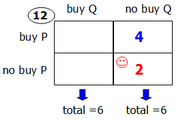
Does this provide enough information to find the number of people in the bottom right box (where the happy face is)?
YES.
Image
Since the two boxed in the right-hand column must add to 6, the bottom right box must have 2 people, which means 2/12 people said that they neither buy product P nor product Q.

Since we can now answer the target question with certainty, the combined statements are SUFFICIENT

Answer = C

Cheers,
Brent

Last edited by Brent@GMATPrepNow on Mon Apr 16, 2018 11:05 am, edited 1 time in total.
Brent Hanneson - Creator of GMATPrepNow.com
Image
Join the discussion

by Brent@GMATPrepNow » Sat Oct 05, 2013 5:42 pm
Brent Hanneson - Creator of GMATPrepNow.com
Image
Join the discussion


















