BlueDragon2010 wrote:The water from one outlet, flowing at a constant rate, can fill a swimming pool in 9 hours. The water from a second outlet, flowing at a constant rate, can fill the same pool in 5 hours. If both outlets are used at the same time, approximately what is the number of hours required to fill the pool?
A) 0.22
B) 0.31
C) 2.50
D) 3.21
E) 4.56
Solution:
This problem is called a combined work problem. In this type of problem we use the formula:
Work (of machine 1) + Work (of machine 2) = Total Work Done
In this particular problem we can define "machine" as "outlet". We are given that the water from one outlet, flowing at a constant rate, can fill a swimming pool in 9 hours and that the water from a second outlet, flowing at a constant rate, can fill the same pool in 5 hours. It follows that the hourly rate for one outlet is 1/9 of the pool per hour and the rate of the other outlet is 1/5 of the pool per hour. Let's let T be the number of hours during which both outlets work together to fill the pool. We'll use the formula Work = Rate x Time to calculate the work accomplished by each outlet individually in filling the pool. We can enter these values into a simple table.
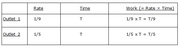
We can plug in the two work values for outlet one and outlet two into the combined worker formula. Note that the Total Work Done is "1" because the pool was filled, thus completing the job of filling the entire pool.
Work (of outlet 1) + Work (of outlet 2) = Total Work Done
T/9 + T/5 = 1
To eliminate the need for working with fractions, let's multiply the entire equation by 45.
45(T/9 + T/5 = 1)
5T + 9T = 45
14T = 45
T = 45/14 = 3 3/14 ≈ 3.21 hours
Answer:
D
Scott Woodbury-Stewart
Founder and CEO
[email protected]
 See why Target Test Prep is rated 5 out of 5 stars on BEAT the GMAT. Read our reviews
























