Hi Jeph86,
Plugging in numbers is not the only way of answering this question in 2 minutes. You can make use of the concept of a
'Quadratic Inequality'.
Let me first explain how to solve a Quadratic Inequality and then explain how to apply this concept in questions similar to question 229 of the OG.
Consider the Quadratic Inequality 3x^2 - 7x + 4 < 0
Factorizing the quadratic inequation we get 3x^2 - 7x + 4 <= 0 --->
(3x - 4)(x - 1) < 0
Now 1 and 4/3 here are referred to as critical points and we place them on number line
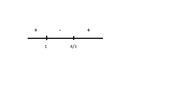
The critical points divide the number line into three regions, now we can get 3 ranges of x
i) x < 1 (all values of x when substituted in (3x - 4)(x - 1) makes the product positive)
ii) 1 < x < 4/3 (all values of x when substituted in (3x - 4)(x - 1) makes the product negative)
iii) x > 4/3 (all values of x when substituted in (3x - 4)(x - 1) makes the product positive)
At this point we should understand that for the inequality (3x-4)(x-1) < 0 to hold true, exactly one of (3x-4) and (x-1) should be negative and other one be positive. The only region that gives us a negative product is the region in between 1 and 4/3
So the range of x that satisfies the inequality 3x^2 - 7x + 4 < 0 is
1 < x < 4/3
The steps to solve a quadratic inequation are as follows:
1. Isolate the variable and always keep the variable positive.
2. Maintain the Inequation in the form ax^2 + bx + c > 0 or < 0.
3. Obtain the critical points of the Inequation.
4. Place the critical points on the number line. The number line will get divided into the three regions.
5. Mark the rightmost region with + sign, the next region with a - sign and the third region with a + sign (alternating + and - starting from the rightmost region).
6. If the Inequation is of the form ax^2 + bx + c < 0, the region having the - sign will be the solution of the given quadratic inequality.
7. If the Inequation is of the form ax^2 + bx + c > 0, the region having the + sign will be the solution of the given quadratic inequality.
This procedure also works for a cubic inequality. the only difference is that we will have three critical points instead of two and 4 regions on the number line. Here again you take the rightmost region as positive and then alternate between the signs.
Now if we have an inequality of the form (x+2)(x+3)/x-2 >=0 then we can transform the question to (x+2)(x+3)(x-2) >= 0 since the conditions that we need to check for in the original inequation will be the same as the conditions that we need to check for in the transformed inequation. The only thing we need to keep in mind here is that in the solution we cannot have x = 2 as it would make the denominator 0.
Now the critical points here are -3, -2 and 2. Placing them on the number line and taking the positive regions we get
x >= 2 and
-3 <= x < = -2. In the solution of x >= 2 we ignore the =2 since the value makes the denominator 0.
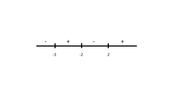
The values of x less than 5 will be 3, 4, -3 and -2.
Keep in mind that if you have similar questions to the one explained above, just transform the question into a product and then use the number line approach to solve. Just make sure you ignore the solution which makes the denominator 0.
To learn similar strategies to solve Inequality questions you can download the free ebook from the link given below.
https://gmat.crackverbal.com/free-resour ... k-library/
Hope this helps!
CrackVerbal Academics Team


























