
BREAKING: Target Test Prep releases Brand New 2026 On Demand GMAT prep course

Redeem

Co-ordinate Geometry Help!

Expert replies
by vinay1983 » Thu Sep 19, 2013 5:46 am
Nemesis is back!
Appreciate any simpler methods! Layman terms if possible.
Image
You can, for example never foretell what any one man will do, but you can say with precision what an average number will be up to!
Join the discussion
Source: — Problem Solving |

by theCodeToGMAT » Thu Sep 19, 2013 6:23 am
Is the Answer

(a) y = x --> (1,1), (2,2)
So contains

(b) y = x + 0.5 -> y - x = 0.5
Not possible

(c) y = x + 5 -> y - x = 5 --> (1,6) (2,7)
So contains

(d) y = 0.5x -> (2,1) (4,2)
So contains

(e) y = 0.5x + 5 -> (2,6) (4,7)
So contains
R A H U L
Join the discussion

by Brent@GMATPrepNow » Thu Sep 19, 2013 6:33 am
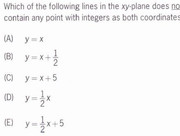
Which of the following lines in the xy-plane does not contain any point with integers as both coordinates?
A) y = x
B) y = x + 1/2
C) y = x + 5
D) y = (1/2)x
E) y = (1/2)x + 5
If a point (x,y) is on a given line, then the coordinates (x and y) of that point must satisfy the equation of that line.

In answer choice B, the equation (y = x + 1/2) tells us that, for ANY POINT ON THE LINE, the y-coordinate will be equal to the x-coordinate plus 1/2
So, if the x-coordinate is an integer, the y-coordinate cannot be an integer.
So, it's impossible for any point on this line to have integers as both coordinates.

Answer: B

Cheers,
Brent
Brent Hanneson - Creator of GMATPrepNow.com
Image
Join the discussion

by Scott@TargetTestPrep » Wed Dec 20, 2017 11:36 am
vinay1983 wrote: Which of the following lines in the xy-plane does not contain any point with integers as both coordinates?
(A) y = x
(B) y = x + 1/2
(C) y = x + 5
(D) y = x*1/2
(E) y = x/2 + 5
We see that the point (1,1) is on the line y = x (answer choice A); (1, 6) on y = x + 5 (C); (2, 1) on y = x*1/2 (D); and (2, 6) on y = x/2 + 5 (E). Thus, the only line that won't have any point with integers as both coordinates is y = x + 1/2 (answer choice B). The reason is simple: if x is an integer, then y can't be an integer, since the sum of an integer and 1/2 will never be an integer. Similarly, if y is an integer, then x can't be an integer, since the difference of an integer and 1/2 (notice that x = y - 1/2) can never be an integer.

Answer: B

Scott Woodbury-Stewart
Founder and CEO
[email protected]

Image

See why Target Test Prep is rated 5 out of 5 stars on BEAT the GMAT. Read our reviews

ImageImage
Join the discussion


















