The square root of a square is a coded way of saying absolute value. Whether the base is positive or negative, squaring will make it positive, and when given a root sign, we only take the positive root:
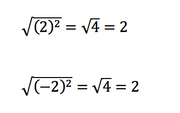
So, we can rephrase the question this way:
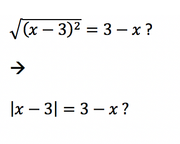
|x - 3| would equal (x - 3) if (x - 3) is greater than or equal to zero. It would equal 3 - x (in other words, -1(x - 3))
if x - 3 is negative.
So the question becomes:
x - 3 < 0 ? -->
x < 3 ?
(1) x not equal to 3
This does not answer our target question. x could still be greater than 3 (giving us a "no" answer to the question) or less than 3 (giving us a "yes" answer to the question). Insufficient.
(2) -x|x| > 0
Since |x| is always positive (for any non-zero x), then the only way to get a positive product of -x and |x| is if -x is positive as well.
If -x is positive, then x must be negative. Since our target question is "is x < 3 ?", then any negative value for x would give us a definitive "yes" answer to the question.
The answer is
B.
Ceilidh Erickson
EdM in Mind, Brain, and Education
Harvard Graduate School of Education























