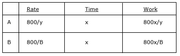
Working simultaneously at their respective constant rates, Machine A and B produce 800 nails in x hours. Working alone at its constant rate, Machine A produces 800 in y hours. In terms of x and y, how many hours does it take Machine B, working alone at its constant rate, to produce 800 nails?
(A) x/(x+y)
(B) y/x+y
(C) xy/(x+y)
(D) xy/(x-y)
(E) xy/(y-x)
Here's the algebraic approach.
It requires us to use two rules:
Rule #1: If it takes k hours to complete a job then, after 1 hour, the job will be 1/k completed.
Example: If it takes Val 5 hours to paint the house, then after 1 hour, she will have painted 1/5 of the house
Rule #2: If, after one hour, a job is x/y completed, the entire job will take y/x hours to complete.
Example: After 1 hour, Pump A has removed 2/7 of the water from the pool. Therefore, it will take a total of 7/2 hours to remove all of the water.
Okay, now to the question.
Given: Working together, Machines A and B produce 800 nails in x hours.
By rule #1, we can say that, after 1 hour, the machines will have completed 1/x of the job (the job being the production of 800 nails)
Given: Working alone, Machine A produces 800 in y hours
By rule #1, we can say that, after 1 hour, Machine A will have completed 1/y of the job (the job being the production of 800 nails)
Important: After one hour, Machine A's contribution + Machine B's contribution = 1/x
We can now write: 1/y + Machine B's contribution = 1/x
So, after one hour, Machine B's contribution = 1/x - 1/y
Combine the fractions to get: Machine B's contribution = y/xy - x/xy = (y-x)/xy
So, in one hour, Machine B can complete (y-x)/xy of the job.
By rule #2, it will take machine B xy/(y-x) hours to complete the job (the job being the production of 800 nails)
So, the answer is E
Cheers,
Brent
Brent Hanneson - Creator of GMATPrepNow.com