Beat The GMAT - the MBA Social Network

 
  • Home
  • Forums
    • Forum Home Page
    • Featured Experts
    • I just Beat The GMAT!
    • Admissions Success Stories
    • GMAT Strategy
    • GMAT Math
      • Problem Solving
      • Data Sufficiency
    • GMAT Verbal and Essays
      • Sentence Correction
      • Critical Reasoning
      • Reading Comprehension
      • GMAT Essays (AWA)
    • Business School
      • Research MBA Programs
      • The MBA Application Process
      • MBA Student Life
    • RSS Feeds
  • Self Study
    • GMAT Library
    • Getting Started
      • Getting Started on Beat The GMAT
      • Intro to GMAT
    • Study Plans
      • The 60-Day GMAT Study Guide
      • Custom GMAT Study Plans
      • 700+ GMAT Student Stories
      • How to Develop a Study Plan
      • 3-Month GMAT Study Plan
      • 1-Month GMAT Study Plan
      • Verbal-Focus GMAT Study Plan
      • 2-Week GMAT Study Plan
      • Retaking the GMAT Plan
      • 3-Month TOEFL Study Plan
      • The Best 'How-To' Study List
    • Books
    • Resource Links
    • Practice
      • Daily GMAT Math Question
      • Daily GMAT Verbal Question
      • Free GMAT Flashcards
      • GMAT Error Logs and Tracking
    • Inspiration
      • I just Beat The GMAT! Success Stories
      • The Beat The GMAT Scholarship
        • 2012 Beat The GMAT Scholarship
        • Beat The GMAT Scholarship Alumni
  • GMAT Courses
    • Verified GMAT Course Reviews
    • GMAT Course Discounts
    • Economist GMAT
      • Economist GMAT Course Reviews
      • Economist GMAT Discounts
      • About Economist GMAT
    • GMAT Prep Now
      • GMAT Prep Now Discounts
      • About GMAT Prep Now
    • Kaplan
      • Kaplan Course Reviews
      • Kaplan GMAT Discounts
      • About Kaplan
    • Knewton
      • Knewton Course Reviews
      • Knewton GMAT Discounts
      • About Knewton
    • Manhattan GMAT
      • Manhattan GMAT Course Reviews
      • Manhattan GMAT Discounts
      • About Manhattan GMAT
    • The Princeton Review
      • The Princeton Review Course Reviews
      • The Princeton Review GMAT Discounts
      • About The Princeton Review
    • Veritas Prep
      • Veritas Prep Course Reviews
      • Veritas Prep GMAT Discounts
      • About Veritas Prep
  • MBA Application
    • MBA Watch
    • MBA Admissions Library
    • MBA Admissions Course
    • Expert Profile Evaluations
    • MBA Essay Breakdowns
      • 2012-2013 Top B-School Essays
      • Berkeley Haas Essays
      • Chicago Booth Essays
      • Columbia Business School Essays
      • Dartmouth Tuck Essays
      • Harvard Business School Essays
      • INSEAD Application Essays
      • Kellogg Essays
      • MIT Sloan Essays
      • Stanford GSB Essays
      • Wharton Essays
    • Research MBA Programs
      • Research MBA Programs Forum
      • School Selection
      • Business School Trends
      • International
    • The MBA Application Process
      • The MBA Application Process Forum
      • Resume
      • Business School Essays
      • Recommendations
      • Interview
      • Waitlist
      • Financial Aid
    • MBA Student Life
      • MBA Student Life Forum
      • MBA Student Life Articles
  • Blogs
    • All GMAT and MBA Blogs
    • Pre-MBA Blogs
    • MBA Student Blogs
    • Business School Blogs
    • GMAT Company Blogs
    • GMAT Tutor Blogs
    • Admissions Consultant Blogs
    • How to Add Your Blog
  • Products
    • GMAT & MBA Marketplace
    • MBA Admissions Course
    • Essay Writing Course
    • Free GMAT Flashcards
    • The 60-Day GMAT Study Guide
    • Daily GMAT Math Question
    • Daily GMAT Verbal Question
    • GMAT Error Logs and Tracking
  • MBA Watch
  • The GMAT/MBA Library
  • GMAT Discounts
  • GMAT Course Reviews
  • MBA Admissions Course

Translating Words into Math

by Stacey Koprince on May 12th, 2011
3 comments
Stacey is a GMAT Instructor living in Montreal. Click here to read more articles from Manhattan GMAT and to learn more about Manhattan GMAT's classes.
Posted in
  • Data Sufficiency
  • GMAT Math
  • Word Problems

I’ve spoken with several students recently who are struggling with translating wordy quant problems into the actual math necessary to set up and solve the problem. Some people make too many mistakes when doing this, and others find that, though generally accurate, they take more time than they can afford. In the next two articles (this is part 1!), we’re going to talk about how to translate efficiently and effectively.

We’re going to do this by example: I’ll provide short excerpts from OG or GMATPrep problems, and then we’ll discuss how to know what to do, how to do the actual translation, and how to do so efficiently. Note that I’m not going to provide the full text of problems – and, therefore, we’re not going to solve fully. That’s not our goal today.

The Basics

Before we dive into more advanced issues, there are some basics we all need to know. We’re not going to spend a lot of time on the basics because all GMAT books out there already explain this; I’ll give a quick introduction and, if you need more, seek out one of the standard books on this topic (in ManhattanGMAT’s books, you’ll find this info in the Algebraic Translations chapter of the Word Translations Strategy Guide).

First, when the problem introduces certain people, objects or other things, we will likely need to assign variables. Cindy can become C and Bob can become B. Next, the words will give us some kind of relationship between variables.

For instance, a sentence might tell us that Cindy is five years older than Bob. We’ve already decided to use C for Cindy and B for B. Next, the “is” represents an equals sign. Five, of course, represents the number 5. Finally “older than” indicates addition; we need a plus sign. Our translated equation becomes C = 5+B. (Another very common word is “of,” which typically means to multiply. For example, ½ of 6 would be written: ½ × 6.)

Notice a couple of things about this equation. We have two unknowns in the sentence, so we should expect to have two variables in the equation. Also, how can we quickly check the equation to see that it makes sense? There are two common ways. We can plug in some simple numbers to test the equation – this might take a little bit longer, but it’s the more certain method. Or we can think about the concepts that have been presented. Who’s older and who’s younger? To which person do we need to add years in order to make their ages equal? We want to add to the younger in order to equal the older. Bob’s the younger one, so we want to add to his age. Does the equation do that?

Here’s an excerpt from an official question, Problem Solving (PS) problem #120 in the Official Guide 12th Edition (OG12):

“David has d books, which is 3 times as many as Jeff and ½ as many as Paula.”

They’ve already defined one variable for us: d for the number of books David has. Let’s use j for Jeff’s books and p for Paula’s books.

Next, take each piece of info separately:

David has d books, and d is (=) 3 times as many as (multiply) j, or d = 3j.

David has d books, and d is (=) 1/2 as many as (multiply) p, or d = 1/2.

Task 1: translate everything and make it real

In OG12, PS problem #91 first tells us that a store sells all of its maps at one specific price and all of its books at another specific price. It also tells us:

“On Monday, the store sold 12 maps and 10 books for a total of $38.00, and on Tuesday the store sold 20 maps and 15 books for a total of $60.00.”

What should we do? First, set variables. Let m = the price for one map and let b = the price for one book. Then, pretend you own the store and a customer walks up with 12 maps and 10 books. What do you do? Make it real – actually visualize (or draw out) what needs to happen.

First, I’d figure out how much I need to charge for the maps: $m each for 12 = 12m. Similarly, the books would cost 10b. You want to buy all of them? Excellent! You owe me 12m + 10b = 38. If we do the same thing with the second half of the sentence quoted above, we get 20m + 15b = 60.

So, we’re done with that – now, we need to solve for m and b, right? Not so fast! Read the actual question first:

“How much less does a map sell for than a book?”

Hmm. They’re not just asking for the price of a map or the price of a book. They’re asking for the difference (“less than”) between the two. Which one costs more and which one costs less?

The sentence is telling us that the map is cheaper. Okay, so if I want the difference in cost between a book and a map, and the map is the cheaper item, how do I do that subtraction? Right, b – m. I actually want to solve for that overall combination (b – m); if I can find a way to do that without solving for b and m individually first, I can save time! (That topic, however, we’ll save for another time.)

Task 2: Where appropriate, use a chart or table to organize

Let’s try another; this is excerpted from PS #154 from OG12:

“An empty pool being filled with water at a constant rate takes 8 hours to fill to 3/5 of its capacity.”

Again, visualize – you’re standing there (for 8 hours!) with the hose, watching the pool fill. How does it work? RTW: Rate × Time = Work. Make a chart:

Okay, so we have one formula: R × 8 = 3/5. The next sentence says:

“How much more time will it take to finish filling the pool?”

To finish filling… hmm, how much more do we have to fill? An entire job = 1. We’ve filled 3/5, so we have 2/5 to go, right? Add another row to your chart:
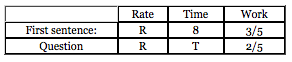
Hey, we’ve got another formula: RT = 2/5. We can use the first one to solve for R, then plug into the second to solve for T.

One more! Let’s try this excerpt from PS #153 from OG12:

“Jack is now 14 years older than Bill. If in 10 years Jack will be twice as old as Bill, how old will Jack be in 5 years?”

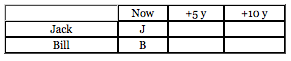
First, set a chart up. We need a row for each person in the problem, and we also need to represent all of the timeframes that are discussed. Careful – there are three timeframes, not two!

Assign variables – decide whether to use one variable or two and decide when to set each base variable (most of the time, we’ll set the base variable to the “Now” timeframe). In the above chart, I’ve set two variables in the Now timeframe.

Next, if you want to use one variable, try to use the simplest piece of information given in the problem to simplify to one variable. In this case, the first sentence is the simplest info because it is set in the “Now” timeframe for both Jack and Bill.

“Jack is now 14 years older than Bill.”

J = 14 + B

Remember, “is” means “equals” and “older than” means “add.” Do you remember how to check your equation quickly to make sure it makes sense?

Who’s older, Jack or Bill? According to the sentence, Jack. The equation adds the 14 to the younger person, Bill. That makes sense.

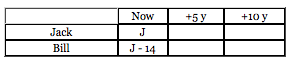
Okay, so we can either remove the J from our table and insert 14 + B instead, or we can flip the equation around (to J – 14 = B), then remove B from the table and insert J – 14 instead. Does it matter? Mathematically, no, but practically speaking, yes – make your life easy by keeping the variable for which you want to solve! We want to solve for Jack, so our new table looks like this:
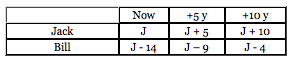
Now fill in the remaining timeframes (you have the info to do this already – just add 5 for the middle column and 10 for the final column!):
What now? Oh, right – now we have that harder second statement to translate:

“If in 10 years Jack will be twice as old as Bill…”

Okay, what timeframe do we need to use? “in 10 years” – okay, go to that column. In 10 years, Jack is J + 10 and Bill is J – 4. Make sure to use these as you translate.

Next, “will be” is a variation of “is” and means “equals.” “Twice” means 2, and “as old as” means multiply. Here’s the translated equation:

J + 10 = 2(J – 4)

Hey, we have an equation with one variable! Now we can solve.

That’s all for today; make sure to check back in next week for more (click here to read Part 2), including how the test-writers will disguise the topic area being tested (and how we can recognize what to do anyway!).

Key Takeaways for Translating:

(1) Know the basics. Certain words consistently mean the same thing (for example, forms of the verb “to be” generally mean “equals). There are lots of great resources out there already that will give you the basics.

(2) Those annoying wordy problems have a lot going on. Make sure you are translating every last thing, and also try to make it real! Insert yourself into the situation; imagine that you are the one doing whatever’s happening and ask yourself what you’d have to do at each step along the way.

(3) When there are multiple variables, multiple timeframes, or other kinds of moving parts, use a chart or table to organize your info. Label everything clearly and only then start filling in.

* GMATPrep® text courtesy of the Graduate Management Admissions Council. Usage of this text does not imply endorsement by GMAC.

* The text excerpted above from The Official Guide for GMAT Review 12th Edition is copyright GMAC (the Graduate Management Admissions Council). The short excerpts are quoted under fair-use statutes for scholarly or journalistic work; use of these excerpts does not imply endorsement of this article by GMAC.

If you liked this article, let Stacey Koprince know by clicking Like.

RELATED ARTICLES

3 comments

  • Prasath on May 12th, 2011 at 11:28 pm

    Succinct!

    Reply to this comment
  • Abe on April 16th, 2012 at 8:05 am

    Great post, just as a follow up, can someone please solve the bookstore question using the method described about simply solving for "B-M" rather then finding the individual values and then subtracting them. Because when I did it, I subtracted the two equations from each other to get 1 value (B or M) and plugged it back into the other.

    Reply to this comment
    • Stacey Koprince on June 9th, 2012 at 12:04 pm

      Hi, sorry I'm replying so late - the alert for your comment didn't come through to me properly.

      So, the reason I left this one for later discussion is that, yes, we should think about whether we can solve for the combination of variables, but it doesn't always work. In this case, it does turn out to be easier to solve in one of the "old fashioned math" ways. :)

      Here's what I'd think if I were doing this one:

      “On Monday, the store sold 12 maps and 10 books for a total of $38.00, and on Tuesday the store sold 20 maps and 15 books for a total of $60.00.”

      let m = cost of maps; let b = cost of books
      EQN 1: 12m + 10b = 38
      EQN 2: 20m + 15b = 60

      Question: b - m = ?

      If I can find a way to solve for the combo, I'll make my life easier, so I'll spend a *little* time seeing whether I can. Otherwise, I'll default to one of the two usual techniques for a system of equations (adding / subtracting or substitution).

      First, I'm noticing that I can simplify the two equations:
      EQN 1: 12m + 10b = 38 --> divide by 2 --> 6m + 5b = 19
      EQN 2: 20m + 15b = 60 --> divide by 5 --> 4m + 3b = 12

      I can see that I can subtract to get 2m + 2b = 7. But I want b - m. Also, In both equations m is more than b, so I'm struggling to figure out how I can get b to be one more and m to be one less than in the other equation (to get b - m).

      At this point, I would abandon this method and use one of the standard methods. I don't have more than 20-30 seconds to spend on trying to find a clever shortcut (and, on this one, it would take way longer than that).

      To illustrate when this does work easily, take a look at another one, #180 from OG12 (for copyright reasons, I can't reproduce the entire problem text here).

      We're given:
      EQN 1: (x+y)/2=60
      EQN 2: (y+z)/2 = 80
      Question: z - x = ?

      y+z = 160 
      x+y = 120
      subtract
      z - x = 40

      Much easier on this one to see what to do. General rule: do look to see whether there's an easy manipulation to solve for the combination of variables (simplifying the equation, multiplying the equation by a number), but if you don't "see" it within 20-30 seconds and maybe one try at a manipulation, then move to one of the two "real math" methods and start solving.

Ask a Question or Leave a Reply

The author Stacey Koprince gets email notifications for all questions or replies to this post.

Guidelines:

Some HTML allowed. Keep your comments above the belt or risk having them deleted. Signup for a Gravatar to have your pictures show up by your comment.

Click here to cancel reply.

FREE GMAT PREP RESOURCES

  • FREE
    GMAT Prep Now Videos and OG13 Improvement Chart
  • FREE
    Kaplan GMAT Practice Test
  • FREE
    Knewton GMAT Challenge Videos
  • FREE
    Manhattan GMAT’s Free Guide To Getting Started With the GMAT
  • FREE
    Free 7-Day Trial with The Economist GMAT Tutor (full access)
  • FREE
    Princeton Review Practice GMAT
  • FREE
    Veritas Prep Free 7-Day Trial - GMAT On Demand

GMAT PREP DISCOUNTS

  • $139 only
    GMAT Prep Now Full Video Course
  • SAVE $150
    Select Kaplan GMAT Courses & Tutoring Services
  • $101 OFF
    Knewton GMAT Complete Prep (5 days only)
  • SAVE $210
    Manhattan GMAT Courses and Services
  • $75 OFF
    The Economist GMAT Tutor
  • 10% OFF
    The Princeton Review GMAT Courses
  • SAVE $770
    Veritas Prep GMAT Courses and Consulting Packages

All GMAT/MBA Articles

  • GMAT AWA Essays (57)
    • Analysis of Argument (29)
    • Analysis of Issue (20)
  • GMAT Horror Stories (1)
  • GMAT Integrated Reasoning (85)
    • Graphics Interpretation (8)
    • Multi-Source Reasoning (7)
    • Table Analysis (10)
    • Two-Part Analysis (10)
  • GMAT Math (758)
    • Algebra (165)
    • Arithmetic (217)
    • Data Sufficiency (260)
    • Geometry (95)
    • Number Properties (121)
    • Permutations/Combinations (27)
    • Probability (53)
    • Problem Solving (279)
    • Statistics (21)
    • Translation (1)
    • Word Problems (124)
  • GMAT Success Stories (59)
    • 600-700 Score (1)
    • 700-800 Score (54)
  • GMAT Test Prep (534)
    • Retake (45)
    • Strategy (399)
    • Stress Management (100)
    • Study Plan (159)
    • Timing (95)
  • GMAT Verbal (679)
    • Critical Reasoning (219)
    • Reading Comprehension (130)
    • Sentence Correction (350)
  • MBA Admissions (2311)
    • Admissions Consulting (612)
    • Essays (677)
    • Extracurriculars (110)
    • GMAT (335)
    • GPA (143)
    • GRE (31)
    • International Admissions (65)
    • Interviews (202)
    • MBA Fairs (37)
    • Rankings (81)
    • Recommendation Letters (164)
    • Resume (121)
    • School Selection (59)
    • School Visits (190)
    • Trends (475)
    • Waitlist (49)
    • Work Experience (219)
  • MBA and Beyond (2537)
    • Career (1591)
    • Clubs (52)
    • Financial Aid (125)
    • Recruiting (208)
    • Student Life (1197)
  • MBA News (167)
  • Videos (590)

FREE UPCOMING GMAT EVENTS

  • June 19
    Free Manhattan GMAT LiveOnline Trial Class
  • June 25
    Free Veritas Prep - Online GMAT Prep Seminar
  • July 9
    Free Kaplan GMAT Preview Class - GMAT Challenge

Follow Us

  • RSS
  • YouTube
  • Twitter
  • Facebook
Beat The GMAT on Facebook

POPULAR RESOURCES

  • MBA Watch
  • MBA Admissions Video Course
  • The GMAT/MBA Library
  • 60-Day GMAT Study Guide
  • GMAT Flashcards
  • GMAT Error Logs
  • GMAT Forums

COURSE LOCATIONS

  • New York GMAT Courses
  • Los Angeles GMAT Courses
  • San Francisco GMAT Courses
  • Boston GMAT Courses
  • Chicago GMAT Courses
  • Houston GMAT Courses
  • Philadelphia GMAT Courses
  • San Diego GMAT Courses
  • Washington D.C. GMAT Courses
  • Dallas GMAT Courses

COURSE REVIEWS

  • GMAT Course Reviews
  • GMAT Tutor from The Economist
  • Grockit GMAT Reviews
  • Kaplan GMAT Reviews
  • Knewton GMAT Reviews
  • Manhattan GMAT Reviews
  • Princeton Review GMAT Reviews
  • Veritas Prep GMAT Reviews
  • About
  • Press
  • Community Rules
© Hobsons, Inc. All rights reserved. Please read our Terms of Service and Privacy Policy